
4-7-8 Breathing Technique: Fall Asleep in Under 60 Seconds
It’s 11:47pm. You’ve been lying in bed for thirty minutes. Your mind is replaying tomorrow’s meeting, that email you forgot to send, and for some reason, something embarrassing you said in 2019. Sound familiar?
The 4-7-8 breathing technique might be the simplest, most effective tool you’ve never tried. Developed by Dr. Andrew Weil — based on the ancient yogic practice of pranayama — this technique has helped millions of people fall asleep faster. Some practitioners report falling asleep in under 60 seconds after mastering it.
Here’s how it works, why it works, and how to make it work for you.
Is 4-7-8 the Right Sleep Tool for You?
4-7-8 works best when the problem is mental or physiological activation: racing thoughts, bedtime tension, shallow breathing, or that wired-but-tired feeling.
It may help less if your main problem is:
- A loud sleep environment
- A room that’s too warm
- Late-night screen use
- A circadian timing issue where you’re simply not sleepy yet
In those cases, pair it with a sleep sound like rain sounds or address the timing problem directly, as in our melatonin guide.
How to Do the 4-7-8 Technique
The pattern is beautifully simple:
- Breathe in through your nose for 4 seconds
- Hold your breath for 7 seconds
- Breathe out through your mouth for 8 seconds
- Repeat for 3-4 cycles
That’s it. One cycle takes 19 seconds. Four cycles take about 76 seconds — just over a minute.
Step-by-Step Guide
Position: Lie on your back or sit comfortably. Place the tip of your tongue against the ridge behind your upper front teeth. Keep it there throughout.
Cycle 1:
- Close your mouth. Inhale quietly through your nose. Count to 4.
- Hold your breath. Count to 7.
- Exhale completely through your mouth, making a gentle “whoosh” sound. Count to 8.
Cycles 2-4: Repeat the same pattern. Don’t force anything — keep it gentle and natural.
Important: The exhale should always be twice as long as the inhale. If counting to 7 or 8 feels too long at first, you can speed up the count — the ratio (4:7:8) matters more than the exact seconds.
Try It Right Now
4-7-8 Breathing Timer
Tap start and follow the circle
Sleep Relax includes a guided breathing timer with haptic feedback. Try the app →
Why Does 4-7-8 Breathing Work?
It Activates Your Parasympathetic Nervous System
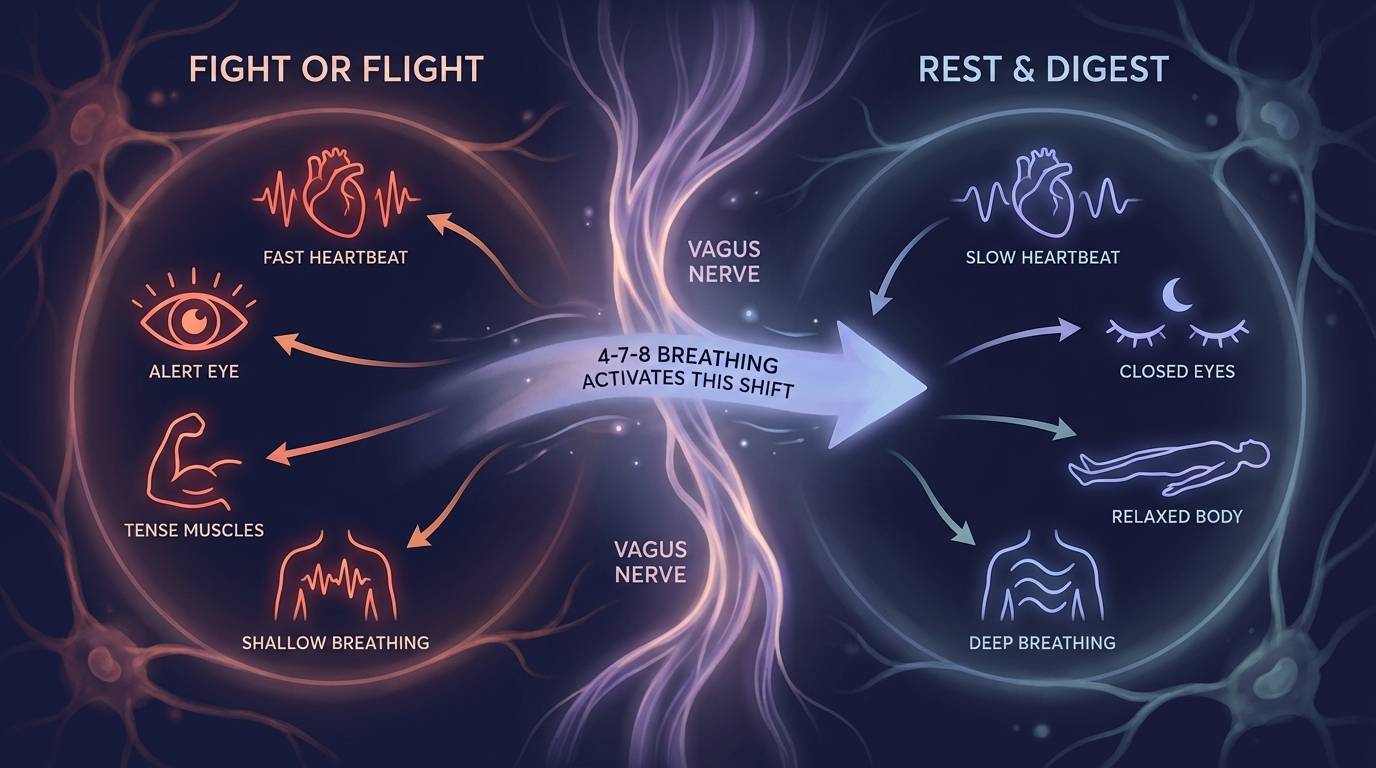
Your body has two modes: “fight or flight” (sympathetic) and “rest and digest” (parasympathetic). When you’re lying awake with racing thoughts, your sympathetic system is running the show — elevated heart rate, shallow breathing, heightened alertness.
The extended exhale in 4-7-8 breathing directly stimulates the vagus nerve, which activates your parasympathetic system. Your heart rate slows, blood pressure drops, and your body shifts into sleep-ready mode.
The Hold Phase Forces Oxygen Absorption
Holding your breath for 7 seconds allows your lungs to fully absorb the oxygen you’ve inhaled. This increases oxygen saturation in your blood, which has a mild sedative effect on your nervous system. It also naturally slows your next breath, deepening the relaxation cycle.
It Gives Your Mind a Task
Half the battle of falling asleep is quieting your mind. The counting pattern in 4-7-8 breathing occupies your conscious mind with a simple, repetitive task — leaving no room for worry spirals. It’s meditation through mechanics.
It Creates a Relaxation Habit
With practice, 4-7-8 breathing becomes a Pavlovian trigger for sleep. Your body learns to associate the breathing pattern with sleeping, and the technique becomes more effective the more you use it. Dr. Weil recommends practising twice daily for the first few weeks.
Research Behind Controlled Breathing
A 2018 review in Frontiers in Psychology found that slow breathing techniques (6 breaths per minute or fewer) consistently improved autonomic function and emotional well-being. The 4-7-8 technique produces approximately 3 breaths per minute — well within the “therapeutic window.”
Research published in The Journal of Alternative and Complementary Medicine found that pranayama-based breathing techniques significantly reduced anxiety and improved sleep quality in participants with insomnia.
While the specific 4-7-8 pattern hasn’t been studied in isolation as extensively as some breathing techniques, the underlying mechanisms — extended exhale, breath retention, rhythmic counting — are all well-supported by respiratory physiology research.
Tips for Success
Start During the Day
Don’t wait until bedtime to try this for the first time. Practice during the day — sitting at your desk, on the bus, during a break. Building the muscle memory when you’re not desperate to sleep makes it more effective when you need it.
Don’t Force the Count
If 7 seconds of holding feels too long, speed up your count. The ratio matters more than the exact duration. You can also start with a 4-4-6 pattern and work up to 4-7-8 over a few days.
Stop If You Feel Light-Headed
Gentle slowing is fine. Dizziness is a sign to back off. Return to normal breathing, shorten the count, and try again later. The technique should feel calming, not effortful.
Combine with Sound
4-7-8 breathing works beautifully with background sound. Try it with:
- Brown noise — the deep rumble complements the breathing rhythm
- Rain sounds — natural variation keeps the background interesting
- Soft ambient music — gentle piano or ambient pads
Sleep Relax includes a guided 4-7-8 breathing timer with haptic feedback, plus calming background sounds to breathe along with.
Try the Breathing TimerBe Patient
The first time you try 4-7-8 breathing, it might feel awkward or make you more aware of your wakefulness. That’s normal. Most people notice significant improvement after 4-7 days of consistent practice. Give it at least a week before deciding if it works for you.
Other Breathing Techniques for Sleep
If 4-7-8 doesn’t click for you, try these alternatives:
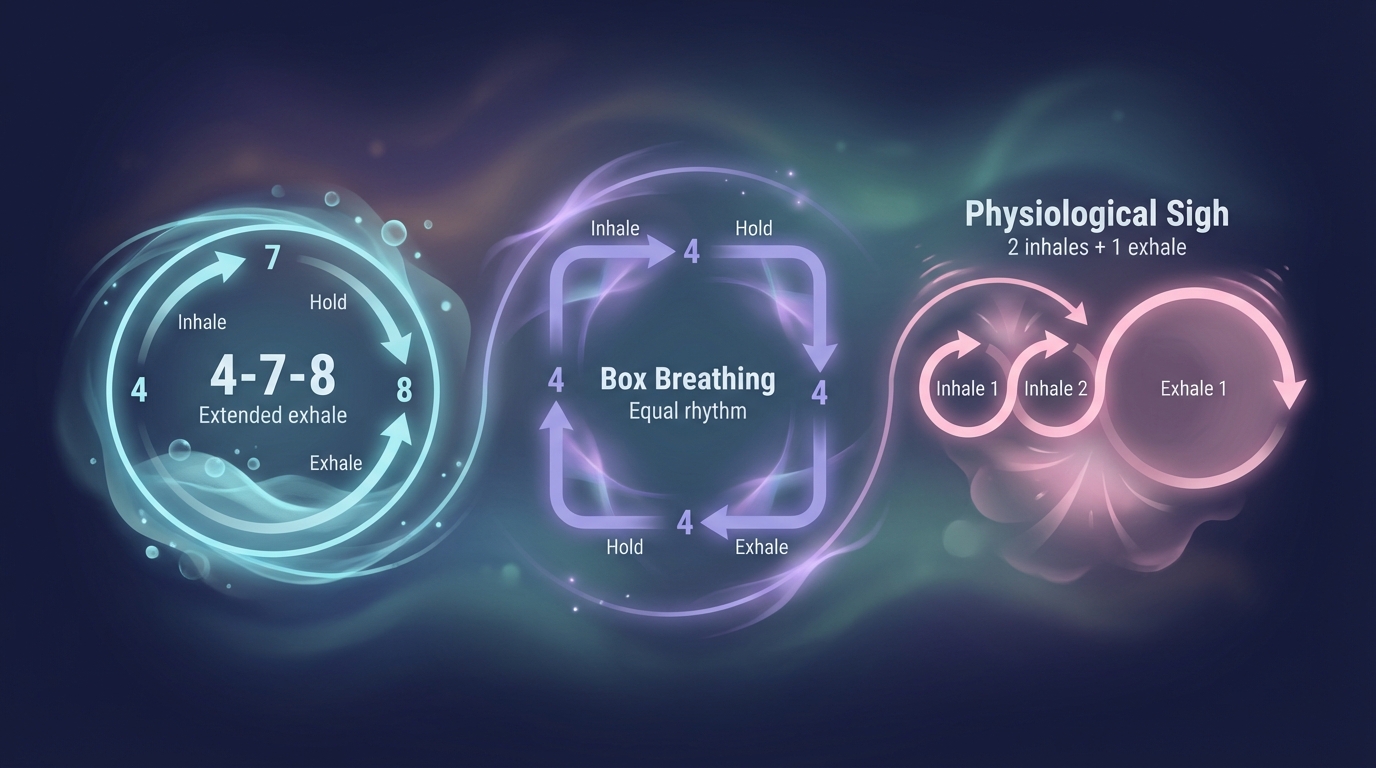
Box Breathing (4-4-4-4)
Inhale for 4, hold for 4, exhale for 4, hold for 4. Used by Navy SEALs for calm under pressure. More rhythmic than 4-7-8.
4-2-6 Breathing
A gentler version of 4-7-8 with a shorter hold. Good for beginners or people who find the 7-second hold uncomfortable.
Physiological Sigh
Two quick inhales through the nose, then one long exhale through the mouth. Discovered by Stanford researchers to be one of the fastest ways to calm down. Can be done in a single breath.
Quick FAQ
Does 4-7-8 really make you fall asleep in 60 seconds?
Sometimes, but not reliably for everyone. Think of “under 60 seconds” as a best-case outcome, not a guarantee.
How many cycles of 4-7-8 should you do?
Start with 3-4 cycles. If that feels comfortable, you can repeat another short round after a normal breath or two.
What if holding for 7 seconds feels too hard?
Speed up the count or shorten the pattern temporarily. The goal is a longer exhale and a steady rhythm, not a breath-holding contest.
The Bottom Line
The 4-7-8 technique is free, portable, has no side effects, and takes about a minute. It’s one of the simplest tools in the sleep toolkit, and it gets more effective with practice.
Tonight, after you get into bed, try 3-4 cycles before reaching for your phone. Breathe in for 4. Hold for 7. Breathe out for 8. Let the rhythm carry you.
Breathe deep, sleep well. 🌙
Sleep better tonight
100+ calming sounds, breathing exercises, and a sleep timer — all in one app.
Download Sleep Relax