40 Hz Sound and Your Brain: What the Alzheimer's Research Really Shows
A clip goes round every few months: scientists at MIT played a buzzing sound 40 times a second and it “cleaned Alzheimer’s out of the brain”. Then come the YouTube videos promising 40 Hz tones that will protect your memory while you sleep.
The real story is more interesting than the clip, and more careful. There is a decade of genuine research here, from one of the most respected neuroscience labs in the world. There are also important unanswered questions, including one independent study that couldn’t reproduce the key result. Here’s what the science actually says, and what it means for anyone thinking of pressing play.
What Is 40 Hz Gamma Stimulation?
Your brain cells communicate in rhythms. Slow delta waves (around 0.5–4 Hz) dominate deep sleep. Faster gamma waves, around 30–100 Hz, show up when you’re awake and focused: paying attention, holding something in working memory, linking information together. The 40 Hz rhythm sits right in this range.
In people with Alzheimer’s disease, and in mouse models of it, gamma activity tends to be disrupted. That led Li-Huei Tsai’s lab at MIT to ask a simple question: if you push the brain back towards a 40 Hz rhythm from the outside, does anything change?
The technique they developed is called GENUS (Gamma ENtrainment Using Sensory stimuli). It involves exposing the brain to light flickering, or sound clicking, exactly 40 times per second. The brain’s sensory areas tend to fall into step with a strong, regular rhythm. This is called entrainment.
What the Research Found
The evidence has built up in stages, and it’s worth separating them.
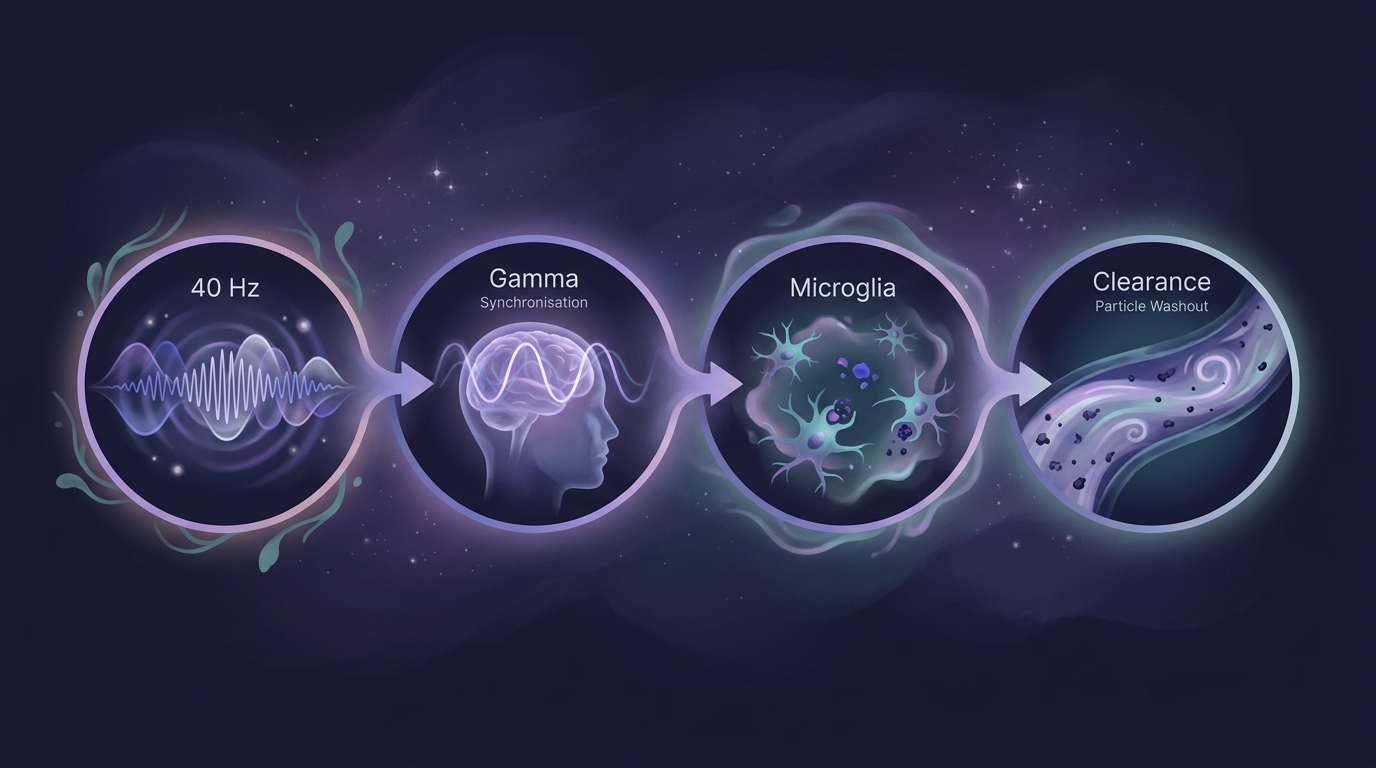
2016: light in mice. In a paper in Nature, the Tsai lab reported that exposing Alzheimer’s model mice to 40 Hz flickering light reduced amyloid-beta, the sticky protein that forms plaques, in the visual cortex. Microglia, the brain’s immune cells, appeared to become more active in clearing it.
2019: sound reaches memory areas. A follow-up in Cell used sound instead: short tones repeated 40 times a second. One week of daily one-hour sessions reduced amyloid in the auditory cortex and, importantly, the hippocampus, a region central to memory. The mice also performed better on memory tasks. Combining sound and light together affected a wider area of the brain than either alone.
2024: the plumbing connection. Another Nature paper linked the effect to the glymphatic system, the brain’s waste-clearance network. In mice, 40 Hz sound and light increased the flow of cerebrospinal fluid through brain tissue and the clearance of amyloid, apparently through a specific type of neuron that signals to blood vessels. That’s the “washing” mechanism behind the viral headlines.
Humans: small but encouraging. A 2022 pilot study in PLOS ONE gave people with mild Alzheimer’s a device delivering 40 Hz light and sound for an hour a day. After three months, the group using real stimulation showed less brain shrinkage and better connectivity between brain regions than a sham group, with some signs of improved daily rhythms and sleep. The study was small, with only around 15 participants. Larger trials are now under way, including a late-stage trial by Cognito Therapeutics, a company spun out of this research.
The Honest Caveats
This is where most of the viral posts stop. They shouldn’t.
- Most of the evidence is in mice. Mouse models of Alzheimer’s don’t fully mirror the human disease, and many treatments that clear amyloid in mice have failed in people.
- It hasn’t replicated cleanly. In 2023, an independent team publishing in Nature Neuroscience tested 40 Hz light flicker and found it didn’t drive strong gamma rhythms deep in the brain and didn’t reduce amyloid in their mice. The MIT group disputes the methods, and the debate is ongoing. That’s normal science, but it means the result is not settled.
- The human trials used medical devices under supervision, not tones from a phone. Their exact sound design, volume and timing were controlled.
- Nobody has shown it prevents Alzheimer’s in healthy people. The studies are in people who already have the condition.
So the fair summary is: a genuinely promising line of research, strongly enough supported to justify large clinical trials, and not yet something you can rely on to protect your brain.
Want to try these sounds tonight? Sleep Relax has 100+ calming sounds with a built-in sleep timer.
Try Sleep Relax Free40 Hz Is Not a Sleep Frequency
This is the most common mix-up. Gamma rhythms are associated with alert, active wakefulness. The research sessions happened during the day while participants were awake.
Deep sleep runs on the opposite end of the spectrum: slow waves below 4 Hz. And deep sleep is when the glymphatic system does most of its natural cleaning. So playing a 40 Hz buzz through the night isn’t what the studies tested, and a fast, insistent rhythm is not what you want when you’re trying to drift off.
It’s also not the same as binaural beats. The research used actual audible clicks or tones pulsing 40 times a second, not two slightly different tones played into each ear. If you’re curious about the sleep-oriented version, our guide to binaural beats for sleep covers the delta range and what that evidence looks like.
If You Want to Try 40 Hz Sound
Listening to 40 Hz audio is generally low-risk for most people, as long as you keep it sensible:
- Listen during the day, not at bedtime. Treat it as an awake, seated session.
- Keep the volume low to moderate. The studies used comfortable levels. Loud, repetitive clicks for an hour can fatigue your hearing.
- Look for pulsed tones or clicks at 40 Hz, which match the research, rather than binaural beats labelled “40 Hz”.
- Skip the flickering light versions if you have epilepsy, a history of seizures or migraines triggered by light. Flicker at these rates can provoke seizures in susceptible people.
- Don’t replace any treatment. If you or someone you care for has memory concerns, see a doctor. 40 Hz sound is not an approved treatment.
What You Can Do Tonight
The most reliable way to support your brain’s own clearance system is the one it evolved: plenty of deep sleep.
- Keep a consistent sleep and wake time
- Keep the bedroom cool and dark
- Limit alcohol, which cuts into deep sleep
- Use steady, gentle background sound to protect against noise that breaks deep sleep. Research on pink noise suggests it may even enhance slow-wave activity, and our deep sleep guide covers the rest
Sleep Relax is built for this side of the equation: calm, continuous soundscapes that help you fall asleep and stay in the deeper stages where the brain does its overnight maintenance.
FAQ
Does 40 Hz sound really clear Alzheimer’s plaques?
In mouse studies from MIT, 40 Hz sound and light reduced amyloid-beta and improved memory, and a small human pilot showed less brain shrinkage. But an independent mouse study didn’t reproduce the effect, and large human trials are still running. It’s promising, not proven.
Can I listen to 40 Hz sound while sleeping?
The research used 40 Hz stimulation during waking hours. Gamma rhythms are linked to alertness, so 40 Hz audio isn’t designed for sleep. For bedtime, slower, steadier sounds like pink noise, brown noise or rain are a better fit.
Are 40 Hz binaural beats the same as the MIT research?
No. The MIT studies used audible tones or clicks pulsing 40 times per second. Binaural beats create a perceived beat from two slightly different tones in each ear, and haven’t been tested in the same Alzheimer’s research.
Is 40 Hz stimulation safe?
Moderate-volume 40 Hz sound is low-risk for most people. Flickering 40 Hz light can trigger seizures in people with photosensitive epilepsy and should be avoided by anyone with that risk. Talk to a doctor before using it for any medical purpose.
This article is for informational purposes only and is not a substitute for professional medical advice. If you have concerns about memory or brain health, please consult a healthcare provider.
Sleep better tonight
100+ calming sounds, breathing exercises, and a sleep timer — all in one app.
Download Sleep Relax