
Box Breathing: The Military Technique for Instant Calm
Navy SEALs use it before missions. Surgeons use it before operations. First responders use it at accident scenes. And you can use it right now, sitting wherever you are, to take back control of your nervous system in under two minutes.
Box breathing (also called square breathing or tactical breathing) is one of the simplest, most reliable techniques for calming anxiety and sharpening focus under pressure. It’s not about relaxation in the soft, candlelit sense — it’s about regulation. Controlled calm when your body is screaming for panic.
How Box Breathing Works
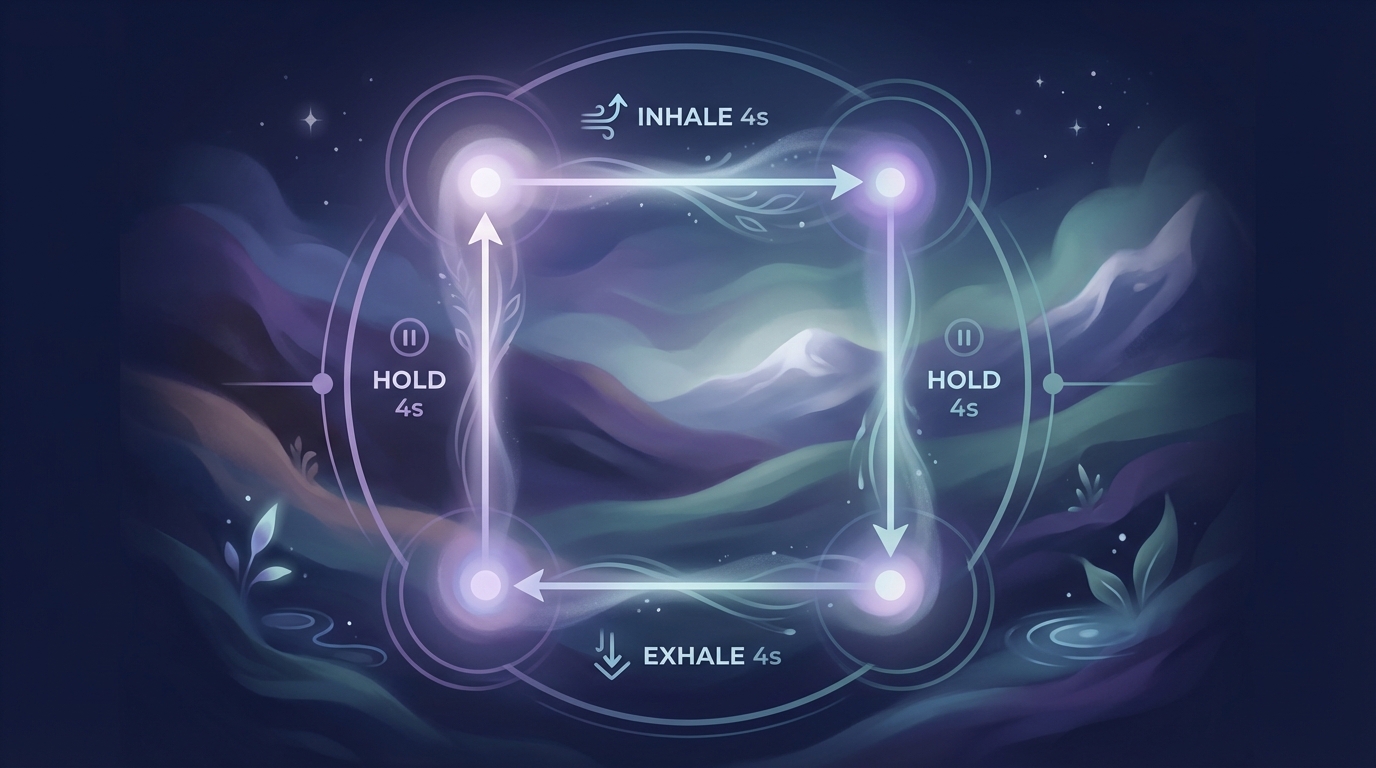
The pattern is a perfect square — four equal sides:
- Inhale through your nose for 4 seconds
- Hold your breath for 4 seconds
- Exhale through your mouth for 4 seconds
- Hold (lungs empty) for 4 seconds
That’s one cycle. Repeat for 4-6 cycles (roughly 2 minutes).
Why It’s Called Box Breathing
Visualise a square. Each side represents one phase. You trace the square with your breath — up (inhale), across (hold), down (exhale), across (hold). Some people literally visualise drawing a box in their mind as they breathe, which doubles as a focus anchor.
The Science Behind the Square
Box breathing works through three mechanisms:
1. Vagus Nerve Activation
The slow, controlled exhale stimulates the vagus nerve, shifting your autonomic nervous system from sympathetic (fight-or-flight) to parasympathetic (rest-and-digest). This is the same mechanism behind other techniques like the 4-7-8 method, but the equal timing gives box breathing a unique advantage for maintaining alertness.
2. CO₂ Tolerance
The breath holds (especially the hold after exhale) gently build your carbon dioxide tolerance. Anxiety often comes with a hypersensitivity to CO₂ — your body panics at normal levels, triggering hyperventilation. Box breathing recalibrates this threshold over time.
3. Cognitive Interruption
Counting to four, four times, while coordinating your breath leaves no room for anxious thought loops. Your prefrontal cortex takes over from the amygdala. You shift from reacting to choosing.
Research published in Frontiers in Psychology (2021) found that structured breathing exercises like box breathing significantly reduced perceived stress and cortisol levels compared to unstructured breathing or no intervention.
Box Breathing vs Other Techniques
If you’ve explored our guide to breathing exercises for anxiety, you know there are several options. Here’s how box breathing compares:
| Technique | Pattern | Best For | Alertness |
|---|---|---|---|
| Box Breathing | 4-4-4-4 | Focus + calm under pressure | Maintains alertness |
| 4-7-8 | 4-7-8 | Falling asleep | Promotes drowsiness |
| Physiological Sigh | 2 inhales + long exhale | Instant panic reset | Quick return to baseline |
| Extended Exhale | 4 in, 6-8 out | General daily anxiety | Mild calming |
The key difference: box breathing keeps you sharp. The equal inhale-to-exhale ratio doesn’t push you toward sleep the way extended exhale patterns do. That’s why military and emergency professionals prefer it — they need calm and clarity.
Want to try these sounds tonight? Sleep Relax has 100+ calming sounds with a built-in sleep timer.
Try Sleep Relax FreeStep-by-Step: Your First Box Breathing Session
Preparation
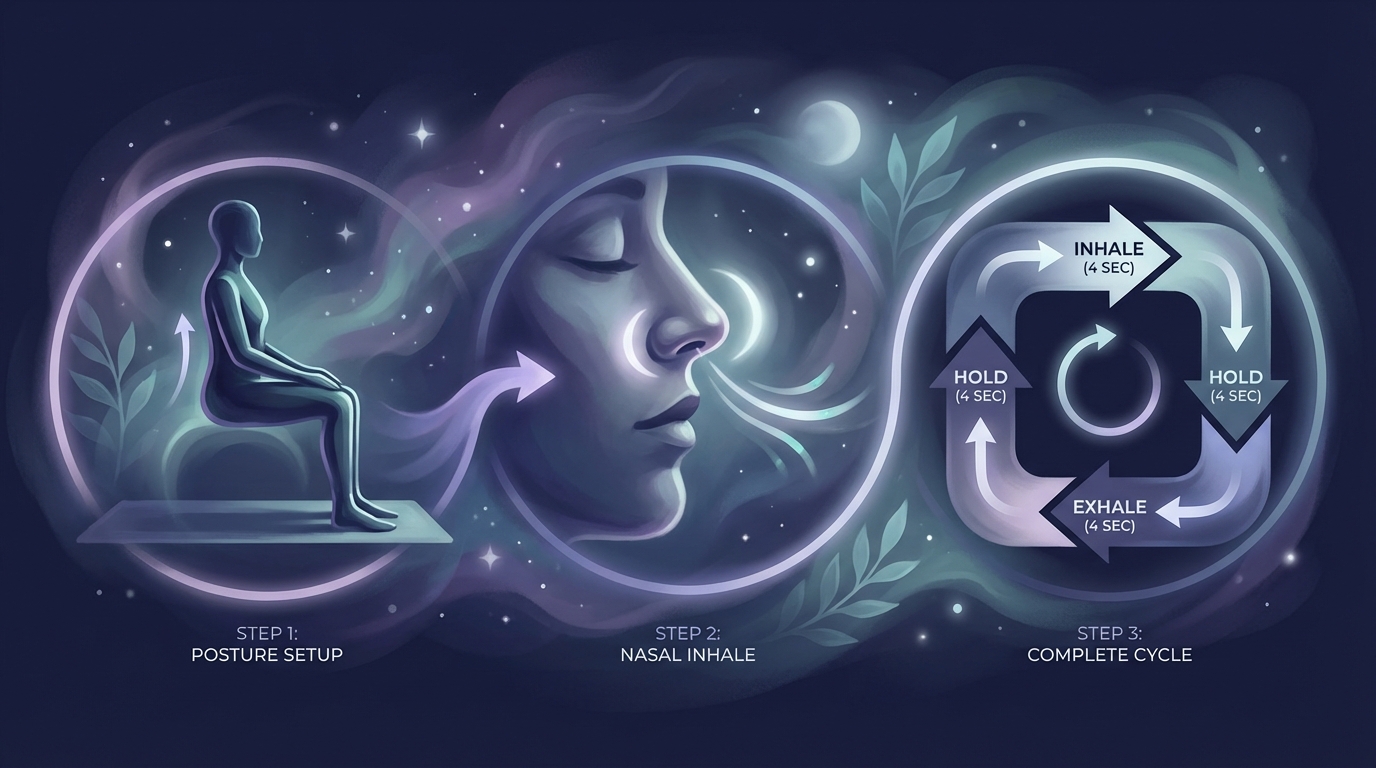
- Sit upright in a chair, feet flat on the floor
- Hands resting on your thighs or in your lap
- Close your eyes or soften your gaze at a fixed point
- Take one natural breath to settle in
The Practice
Cycle 1 — Finding the rhythm:
- Inhale through your nose: 1… 2… 3… 4…
- Hold: 1… 2… 3… 4…
- Exhale through your mouth: 1… 2… 3… 4…
- Hold (lungs empty): 1… 2… 3… 4…
Cycle 2 — The empty hold feels strange at first. That’s normal. Don’t gasp on the next inhale — ease into it.
Cycles 3-4 — By now, your heart rate should be noticeably slower. Your shoulders may have dropped from your ears.
Cycles 5-6 — If you need more, continue. Most people feel a shift within 4 cycles.
Troubleshooting
“The 4-second hold after exhale is uncomfortable.” Start with 3 seconds on the holds, 4 on inhale/exhale. Work up to 4-4-4-4 over a week.
“I feel lightheaded.” You’re trying too hard. The breaths should be comfortable, not maximal. You’re not trying to fill your lungs completely — just breathe naturally at a controlled pace.
“My mind still races.” Visualise the box. Literally picture drawing each side as you complete each phase. This gives your visual cortex something to do, which helps quiet the verbal chatter.
When to Use Box Breathing
Box breathing fits anywhere because it doesn’t require closing your eyes, lying down, or any special position:
- Before a meeting or presentation — 4 cycles in the bathroom or at your desk
- During a commute — use it on the train or as a passenger (not while driving)
- After a stressful interaction — reset your nervous system before the stress compounds
- Before sleep — though for sleep specifically, you might prefer the 4-7-8 technique or a sleep meditation
- During a workout break — between sets, use it to lower heart rate and refocus
Building a Box Breathing Habit
The research is clear: breathing exercises work best with regular practice, not just emergency use. A 2022 study in Cell Reports Medicine found that just 5 minutes of daily breathwork over 4 weeks produced lasting reductions in anxiety and resting respiratory rate.
Start with:
- Week 1: 2 minutes (3 cycles) once a day, same time each day
- Week 2: 2 minutes twice a day — morning and afternoon
- Week 3: Increase to 4-5 cycles per session
- Week 4: Add situational use — reach for it whenever stress spikes
Try It with Sound
Box breathing is powerful on its own. With the right ambient background — gentle brown noise, soft rain, or a low drone — it becomes almost meditative. The sound gives your brain an additional anchor and masks distracting environmental noise.
Sleep Relax includes a built-in breathing timer you can pair with any soundscape. No counting in your head — just follow the visual guide and breathe.
Want to try these sounds tonight? Sleep Relax has 100+ calming sounds with a built-in sleep timer.
Try Sleep Relax FreeThis article is for informational purposes only and is not a substitute for professional medical advice. If you experience persistent anxiety or stress, please consult a healthcare provider.
Sleep better tonight
100+ calming sounds, breathing exercises, and a sleep timer — all in one app.
Download Sleep Relax