Breathing Exercises for Anxiety: Calm Your Mind Anytime, Anywhere
Your chest tightens. Your thoughts start looping. You know you should “just breathe” — but how you breathe matters far more than people realise.
If you’ve tried the 4-7-8 breathing technique for sleep, you already know that controlled breathing can shift your nervous system. But anxiety doesn’t only visit at bedtime. It shows up in meetings, on the commute, at 2pm on a Tuesday when nothing is technically wrong but everything feels too much.
This guide covers five breathing techniques specifically chosen for anxiety — not sleep onset, but the kind of racing, restless tension that follows you through the day.
Why Breathing Actually Works for Anxiety
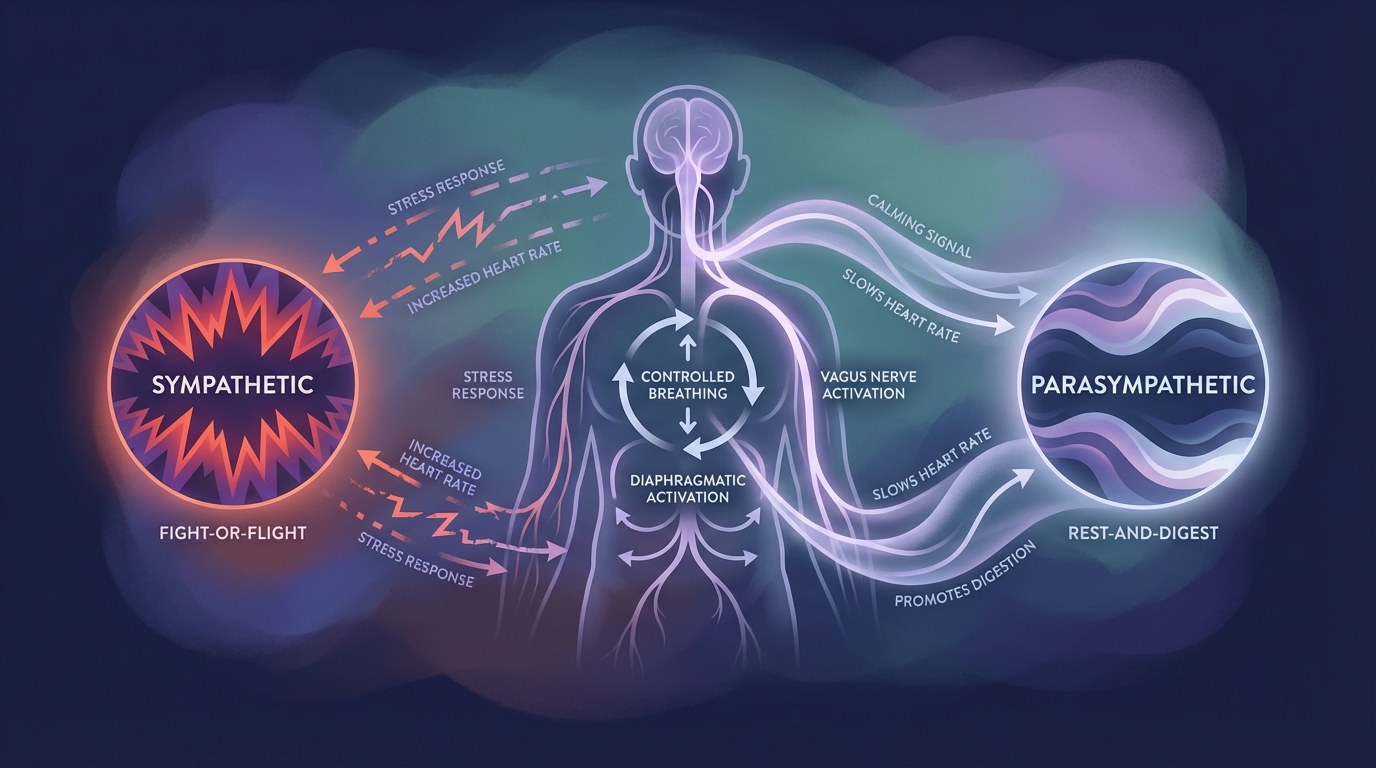
This isn’t woo-woo. When you’re anxious, your sympathetic nervous system (the fight-or-flight response) takes over. Your breathing becomes shallow and fast, which reinforces the anxiety in a feedback loop.
Slow, deliberate breathing activates the vagus nerve — the longest cranial nerve in your body — which triggers your parasympathetic nervous system (the rest-and-digest response). Heart rate drops. Cortisol decreases. The loop breaks.
A 2023 Stanford study found that structured breathing exercises reduced anxiety and improved mood more effectively than mindfulness meditation alone. The key? Active control over exhalation.
5 Breathing Techniques for Anxiety
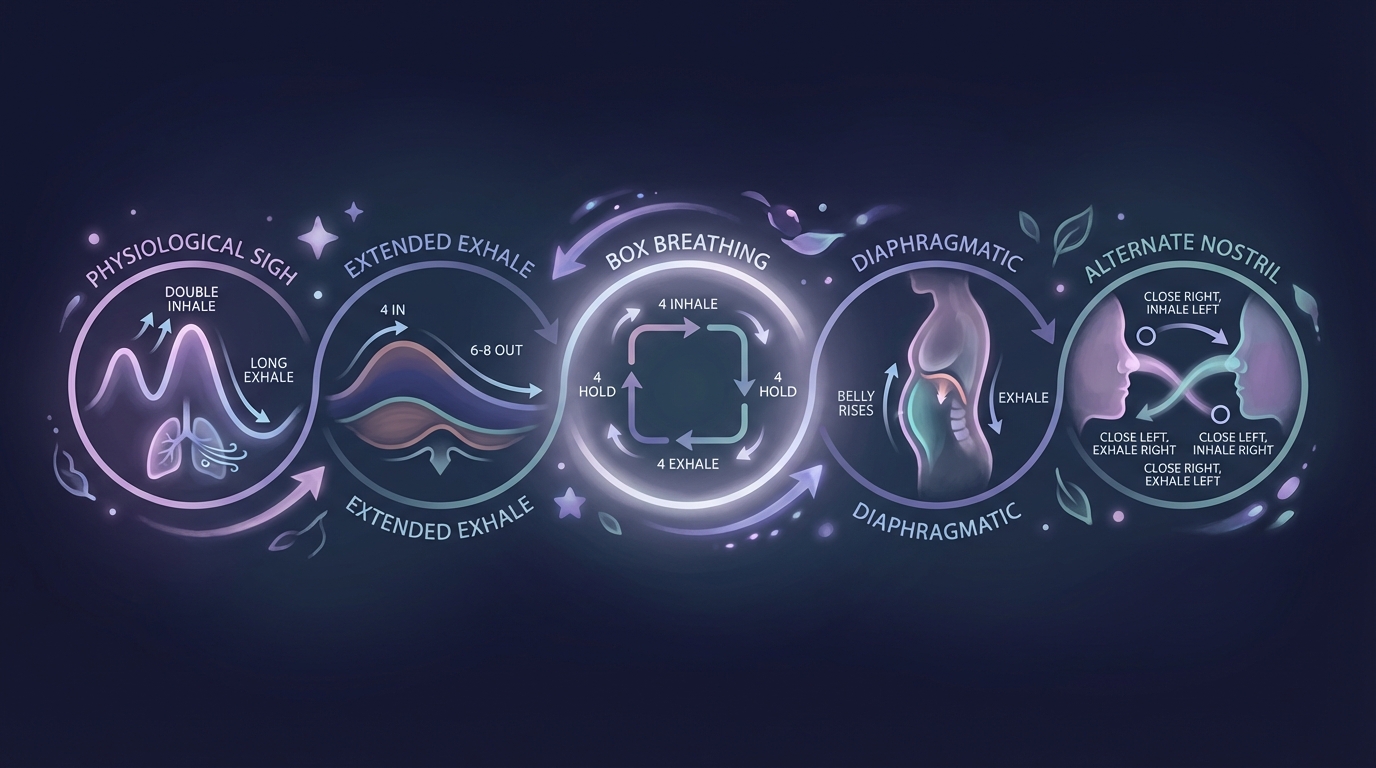
1. The Physiological Sigh (Fastest Relief)
Discovered by Stanford neuroscientist Andrew Huberman, this is the body’s natural reset button — you actually do it involuntarily when crying or right before falling asleep.
How to do it:
- Take a deep breath in through your nose
- At the top, sneak in a second short inhale (a “double inhale”)
- Let out a long, slow exhale through your mouth
Why it works: The double inhale maximally inflates your lung’s alveoli, which triggers a rapid CO₂ release on the exhale. One sigh can shift your state in seconds.
Best for: Acute anxiety moments — before a presentation, during a difficult conversation, when you feel panic rising.
2. Extended Exhale Breathing (Daily Anxiety)
The simplest technique with the strongest research backing. Any pattern where the exhale is longer than the inhale will calm you down.
How to do it:
- Inhale for 4 seconds
- Exhale for 6-8 seconds
- Repeat for 2-5 minutes
Why it works: Longer exhales stimulate the vagus nerve more than any other breathing pattern. It’s the mechanism behind why sighing feels good.
Best for: Generalised anxiety, work stress, the afternoon tension that builds without a clear trigger.
3. Box Breathing (Structured Calm)
Used by Navy SEALs and first responders to stay calm under extreme pressure. We’ve written a complete guide to box breathing if you want to go deeper.
How to do it:
- Inhale for 4 seconds
- Hold for 4 seconds
- Exhale for 4 seconds
- Hold for 4 seconds
- Repeat for 4-6 cycles
Best for: When your mind needs structure — the equal timing gives your brain something to focus on, which interrupts anxious thought spirals.
4. Diaphragmatic (Belly) Breathing
Most anxious people breathe from their chest. Shifting to belly breathing is one of the most powerful long-term habits you can build.
How to do it:
- Place one hand on your chest, one on your belly
- Breathe in through your nose — only the belly hand should rise
- Exhale slowly through your mouth
- The chest hand should barely move
Why it works: Chest breathing keeps you in a shallow, alert state. Belly breathing engages the diaphragm fully, which physically compresses the vagus nerve and triggers relaxation.
Best for: Building a daily practice that lowers your baseline anxiety over weeks.
5. Alternate Nostril Breathing (Nadi Shodhana)
A yogic technique with surprisingly strong research support. A 2019 study in the Journal of Education and Health Promotion found it significantly reduced anxiety scores in medical students.
How to do it:
- Close your right nostril with your thumb
- Inhale through the left nostril for 4 seconds
- Close the left nostril with your ring finger, release the right
- Exhale through the right nostril for 4 seconds
- Inhale through the right nostril
- Switch and exhale through the left
- Repeat for 5-10 cycles
Best for: A mindful practice when you have a few minutes — before a meal, on a break, winding down in the evening.
Want to try these sounds tonight? Sleep Relax has 100+ calming sounds with a built-in sleep timer.
Try Sleep Relax FreeHow This Differs from Breathing for Sleep
If you’ve read our 4-7-8 breathing guide, you might wonder — can’t I just use that for anxiety too?
You can. But there’s a difference in approach:
- Sleep breathing (like 4-7-8) is designed to progressively slow everything down toward unconsciousness. The long hold and extended exhale ratio push you toward drowsiness.
- Anxiety breathing needs to calm you while keeping you alert. Techniques like the physiological sigh or box breathing bring you back to baseline without making you sleepy.
The best approach: use anxiety-focused techniques during the day, and save 4-7-8 for bedtime. If your anxiety peaks at night and keeps you awake, try extended exhale breathing first — and if you’re curious about combining breathing with sleep meditation, that’s a powerful combination.
Building a Breathing Practice
You don’t need to do all five. Here’s a practical framework:
- Panic moment? → Physiological sigh (one breath, instant reset)
- Stressful day? → Extended exhale breathing for 3 minutes
- Need focus under pressure? → Box breathing for 4-6 cycles
- Daily practice? → 5 minutes of diaphragmatic breathing, morning or evening
- Mindful moment? → Alternate nostril breathing before a meal
The key is consistency, not perfection. Even two minutes of intentional breathing changes your physiology measurably.
Try It Right Now
Pick the technique that matches your current state. Set a timer for two minutes. Just breathe.
If you want guided breathing with visual timers, haptic feedback, and calming soundscapes behind it, Sleep Relax has built-in breathing exercises you can pair with ambient sounds — so you don’t have to count in your head.
Want to try these sounds tonight? Sleep Relax has 100+ calming sounds with a built-in sleep timer.
Try Sleep Relax FreeThis article is for informational purposes only and is not a substitute for professional medical advice. If you experience persistent anxiety, please consult a healthcare provider.
Sleep better tonight
100+ calming sounds, breathing exercises, and a sleep timer — all in one app.
Download Sleep Relax