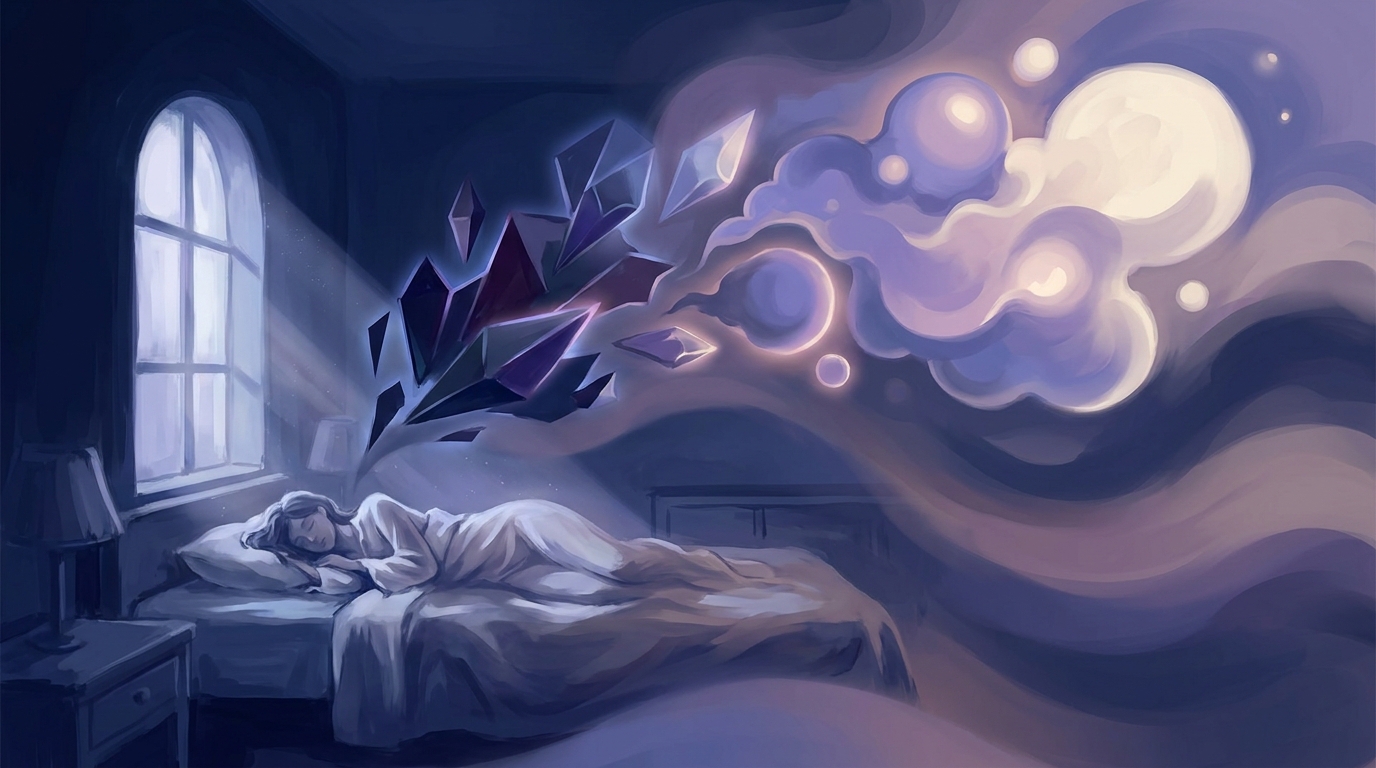
The Cognitive Shuffle: How Random Mental Images Help You Fall Asleep
You’re lying in bed, and your mind won’t stop. Tomorrow’s meeting. That email you forgot to send. Whether you locked the front door. The thoughts loop and multiply, and the harder you try to push them away, the louder they get.
What if, instead of fighting your racing mind, you could simply redirect it — filling it with images so random and meaningless that worry has nowhere to land?
That’s the cognitive shuffle. And according to a trial of over 150 people, it works.
What the Cognitive Shuffle Is
The cognitive shuffle is a sleep onset technique developed by Luc Beaudoin, a cognitive scientist at Simon Fraser University. The principle is simple: you picture a series of random, unrelated images in your mind — a red balloon, a wooden barn, a lemon, a lighthouse — changing the image every few seconds.
That’s it. No mantras. No breathing patterns. No counting. Just loose, disconnected pictures, one after another, until you drift off.
It sounds almost too simple to work. But the mechanism behind it is surprisingly elegant.
Why Random Images Shut Down Racing Thoughts
Your working memory — the part of your brain that holds and manipulates conscious thoughts — has limited capacity. When you worry at night, your working memory is fully occupied: constructing scenarios, rehearsing conversations, calculating consequences.
The cognitive shuffle exploits this constraint. By filling your working memory with a stream of unrelated images, you leave no room for the structured, logical thinking that worry requires. Your prefrontal cortex can’t simultaneously picture a penguin wearing a hat AND plan tomorrow’s difficult conversation. One displaces the other.
Matt Walker, professor of neuroscience at UC Berkeley, explains it this way: worry requires your working memory to hold connected, meaningful thoughts in sequence. The cognitive shuffle breaks that sequence by feeding in images that have no logical connection to each other. Your brain can’t build a worry narrative from a balloon, a barn, and a lemon.
There’s a second mechanism at work too. Random, disconnected imagery closely resembles what happens during sleep onset — the hypnagogic stage when your thoughts naturally become loose, fragmented, and image-based. By deliberately producing this kind of thinking, you’re essentially mimicking the brain’s own transition into sleep. You’re faking the cognitive signature of drowsiness, and your brain takes the hint.
How to Do It: Three Methods
Method 1: The Letter Method (Easiest)
- Pick a random letter — say, B
- Think of a word starting with that letter: banana
- Picture a banana clearly for 3-5 seconds
- Think of another B word: bridge
- Picture a bridge for 3-5 seconds
- Continue: balloon, beaver, bookshelf, blanket…
- When you run out of B words (or get bored), move to another letter
The key: don’t try to connect the images. Don’t build a story. Each image should be completely independent of the last.
Method 2: Free Association
Skip the letter constraint entirely. Just picture random objects, scenes, and things:
- A yellow rubber duck
- A mountain covered in snow
- A steaming cup of tea
- A cat sitting on a windowsill
- A lighthouse beam sweeping across fog
Change the image every 3-5 seconds. If a thought intrudes (“Did I reply to that email?”), don’t fight it — just return to the next image.
Method 3: The Scenario Method
Place yourself in a familiar, calm environment — a market, a garden, a beach — and slowly look around, noticing random objects without narrating or analysing them. A pile of oranges. A wooden crate. A bird on a railing. A green umbrella.
This gives your mind a gentle structure without the logical thread that keeps you awake.
What the Research Shows
Beaudoin’s trial involved over 150 participants who used the cognitive shuffle at bedtime. Those who used the technique reported falling asleep significantly faster than their baseline and faster than a control group.
The technique appears to work by occupying the working memory resources that rumination and worry depend on. When those resources are redirected to meaningless imagery, the arousal system loses its fuel.
This aligns with broader insomnia research. If you’ve read about the sleep effort paradox — the finding that trying to sleep actually keeps you awake — the cognitive shuffle addresses the same problem from a different angle. Instead of telling yourself to stop trying (which is its own form of effort), you give your mind something harmless to do. The effort dissolves not through willpower but through distraction.
Want to try these sounds tonight? Sleep Relax has 100+ calming sounds with a built-in sleep timer.
Try Sleep Relax FreeTips for Making It Work
Keep images concrete and visual. “Justice” or “freedom” are abstract — your brain will start analysing them. “A red fire truck” or “a sleeping cat” are concrete and easy to picture without triggering analytical thought.
Don’t worry about running out of images. If you blank on the next word, just sit with the last image a little longer, or switch letters. The pressure to perform perfectly is exactly what you’re trying to avoid.
Embrace boredom. If the exercise feels monotonous, that’s the point. Boredom is a signal that your arousal system is winding down. Don’t try to make it interesting.
Use it alongside sound. Many people find that combining the cognitive shuffle with ambient sound — rain, brown noise, or ocean waves — creates an even more effective sleep environment. The sound occupies your auditory attention while the images occupy your visual working memory, leaving very little bandwidth for worry.
Don’t judge the results on night one. Like any skill, the cognitive shuffle becomes more effective with practice. Your brain learns the association: random images → sleep onset. Give it a week.
When the Cognitive Shuffle Works Best
The technique is particularly effective for:
- Rumination-driven insomnia — when you can’t stop thinking about problems, mistakes, or tomorrow’s tasks
- Sleep performance anxiety — when you’re trying so hard to fall asleep that the effort itself keeps you awake
- Bedtime procrastination recovery — when you’ve finally put down the phone but your mind is still buzzing
- Middle-of-the-night waking — when you wake up at 3am and your brain immediately starts planning
It’s less suited for insomnia caused by physical discomfort, medical conditions, or external noise — those have different root causes that need different solutions.
A Technique for the Overthinkers
If you recognise yourself in any of this — the midnight mental loops, the frustration of a busy mind that won’t switch off — the cognitive shuffle might be the simplest tool you haven’t tried. It doesn’t require an app, a subscription, or a lifestyle change. Just a willingness to picture a balloon, a barn, and a lemon, and let your thoughts go nowhere.
Your brain already knows how to fall asleep. The cognitive shuffle just gets your conscious mind out of the way.
This article is for informational purposes only and is not a substitute for professional medical advice. If you have persistent sleep issues, please consult a healthcare provider.
Sleep better tonight
100+ calming sounds, breathing exercises, and a sleep timer — all in one app.
Download Sleep Relax