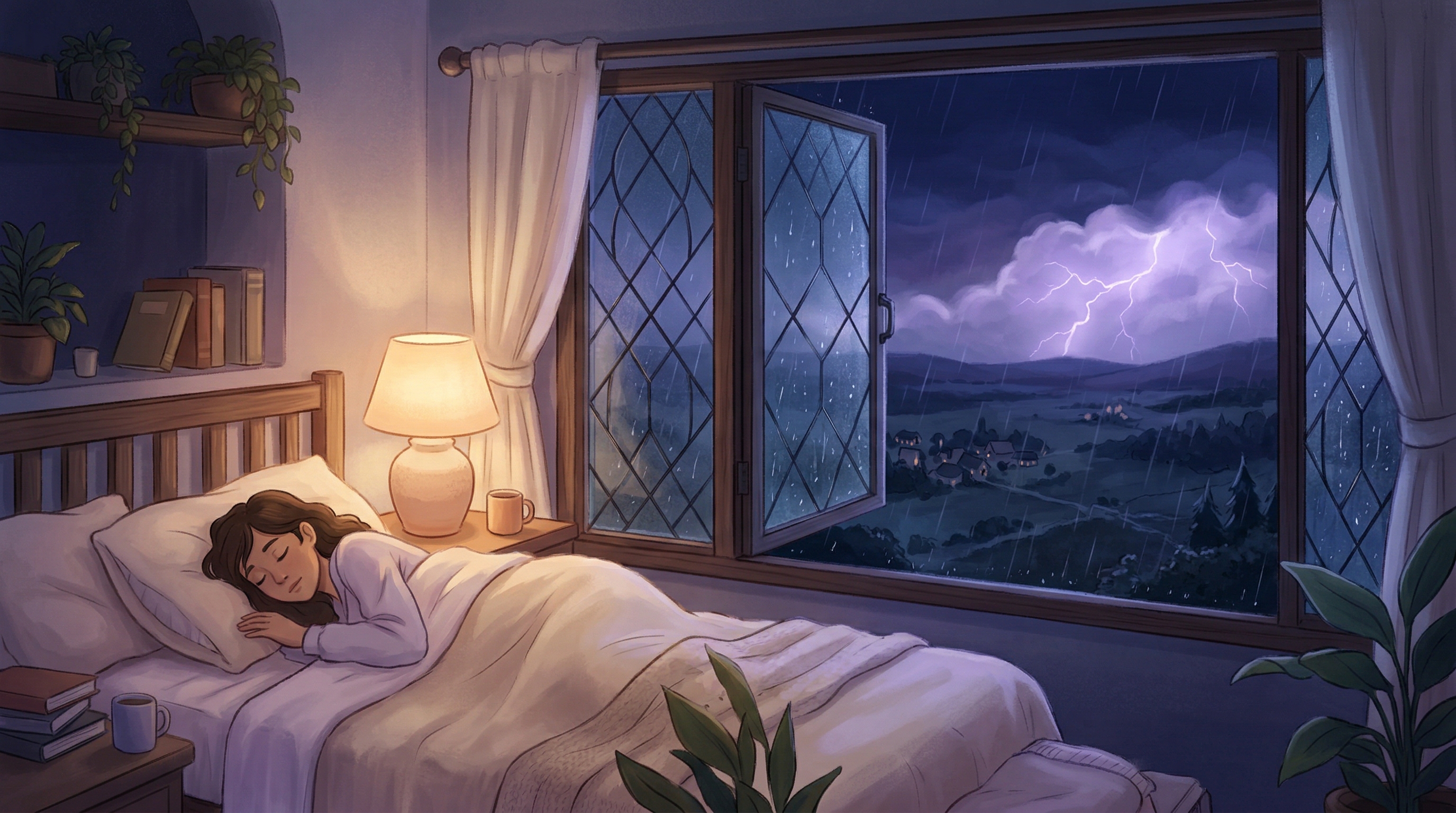
Why Your Brain Was Built to Sleep With Sound: The Evolutionary Science
Why Your Brain Was Built to Sleep With Sound: The Evolutionary Science
If you struggle to fall asleep in a dead-silent room, you aren’t weird, broken, or overly sensitive. In fact, your brain is doing exactly what millions of years of evolution trained it to do.
In the modern world, we spend thousands of dollars on soundproofing, double-glazed windows, and earplugs, chasing the holy grail of total silence. But as leading sleep scientists like Dr. Matthew Walker have recently pointed out: humans didn’t evolve for silent sleep. Silence is a modern novelty—and to your primitive brain stem, total silence doesn’t mean “peaceful.” It means “danger.”
The Myth of the Silent Night
For 99.9% of human history, sleep was an incredibly noisy affair.
Anthropological studies of modern hunter-gatherer tribes, like the Hadza in Tanzania, reveal that ancestral sleep environments were filled with continuous, rich acoustic textures. The crackle of the campfire, the rustle of wind through the savannah grass, the rhythmic chirping of insects, and the breathing of tribe members sleeping nearby.
When the environment went completely silent, it usually meant a predator was nearby and the local wildlife had frozen in fear. In an evolutionary context, sudden silence is an alarm bell. When you lie in a perfectly quiet, modern bedroom, your brain’s threat-detection system stays on high alert, waiting for a sound to process. Every tiny creak of the floorboards or distant car horn becomes a potential threat, spiking your cortisol and pulling you out of deep sleep.
Your Brain Never Stops Listening
You might think that when you fall asleep, your ears turn off. They don’t.
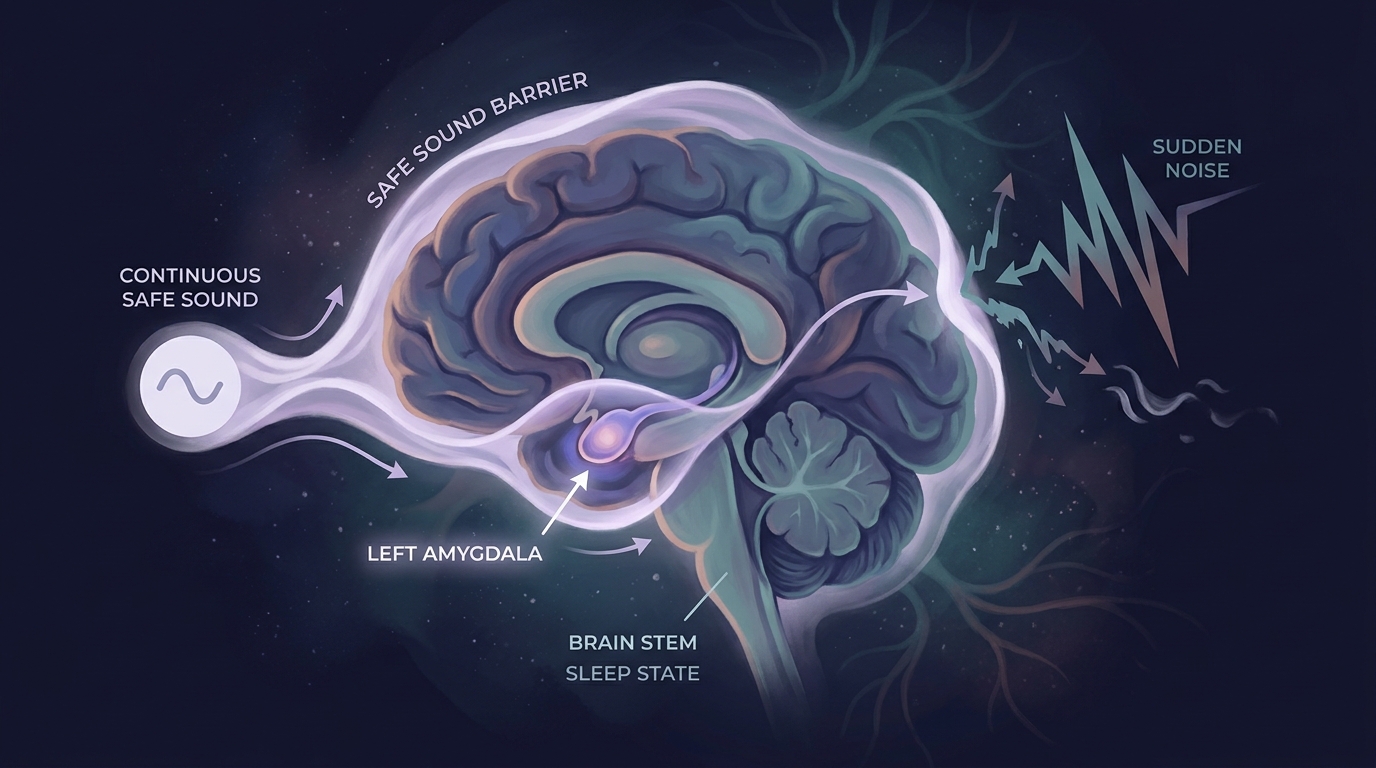
Neuroscience shows that while your conscious mind shuts down, your brain’s auditory processing centers—specifically the left amygdala—continue to monitor the environment. This is an unconscious threat-detection system. It’s why you can sleep through a loud thunderstorm, but instantly wake up if someone softly whispers your name. Your brain is sorting sounds into “safe background noise” and “relevant anomalies.”
When you provide your brain with a continuous, predictable soundscape—like brown noise, heavy rain sounds, or distant ocean waves—you are effectively giving your amygdala a blanket of safety. You are signaling to your nervous system: The environment is stable. The tribe is safe. You can power down.
Pink Noise and Memory Consolidation
The relationship between sound and sleep goes even deeper than simple masking. Sound can actually change your brainwaves.
Recent clinical studies have demonstrated that when bursts of pink noise are played in perfect sync with the slow brainwaves of deep sleep, it actually enhances the amplitude of those waves. This acoustic stimulation has been shown to improve memory consolidation overnight. Your brain uses the rhythmic sound to anchor its deepest, most restorative stages of rest.
In the animal kingdom, this integration of environment and sleep is even more extreme. Dolphins, for example, use unihemispheric sleep—shutting down one half of their brain while the other half stays awake to listen, breathe, and swim. While humans don’t go to that extreme, we still rely on environmental cues to regulate our vulnerability.
Want to try these sounds tonight? Sleep Relax has 100+ calming sounds with a built-in sleep timer.
Try Sleep Relax FreeHow to Recreate Ancestral Safety Tonight
If you’re tired of jolting awake at every house creak, you can easily hack your environment to mimic the acoustic safety your brain evolved to expect.
- Avoid pure white noise: White noise is harsh and high-frequency, mimicking the hiss of static. Instead, opt for lower-frequency sounds. Brown noise mimics the deep roar of a waterfall, while pink noise mimics the rustle of leaves or steady rain.
- Layer your soundscape: In nature, sounds don’t exist in isolation. Try mixing a steady base layer (like brown noise) with a dynamic layer (like a crackling campfire or gentle rain) to create a rich, natural acoustic environment.
- Keep it continuous: Ensure your sound source plays all night. If your sound machine shuts off at 3 AM, the sudden drop into silence is likely to trigger an adrenaline response and wake you up.
- Volume matters: Set the volume to a comfortable level that masks household noises but isn’t so loud that it becomes the focal point of your attention.
Frequently Asked Questions
Is it bad to sleep in total silence?
Not necessarily, if you naturally sleep well that way. However, if you find yourself anxious, prone to racing thoughts, or easily woken by minor noises, total silence may be keeping your brain’s threat-detection system on high alert.
Why do I need the TV on to fall asleep?
Many people use the TV to create a sense of presence and safety, mimicking the “tribe” sleeping nearby. However, the fluctuating volume, bright blue light, and engaging dialogue often disrupt deep sleep. Transitioning to continuous, non-verbal audio like nature sounds or brown noise provides the safety signal without the disruption.
What is the best sound for deep sleep?
Research suggests that pink noise and brown noise are highly effective for sleep. Pink noise has been clinically shown to enhance slow-wave deep sleep, while brown noise provides excellent masking for disruptive environmental sounds due to its deep, rumbling frequency.
This article is for informational purposes only and is not a substitute for professional medical advice. If you have persistent sleep issues, please consult a healthcare provider.
Sleep better tonight
60+ calming sounds, breathing exercises and a gentle 14-night sleep plan — all in one app.
Download Sleep Relax