How Exercise Improves Sleep: What 4.3 Million Nights of Data Reveal
How Exercise Improves Sleep: What 4.3 Million Nights of Data Reveal
You’ve probably heard the golden rule of sleep hygiene: never exercise right before bed. For decades, the advice has been that late-night workouts spike your heart rate, elevate your core temperature, and leave you tossing and turning until 2 AM. But what if that rule was completely wrong?
Recent massive datasets and clinical trials are completely rewriting what we know about the relationship between physical activity and rest. If you’ve been skipping your evening workouts because you’re worried about ruining your sleep, you might actually be doing more harm than good.
The 4.3 Million-Night Experiment
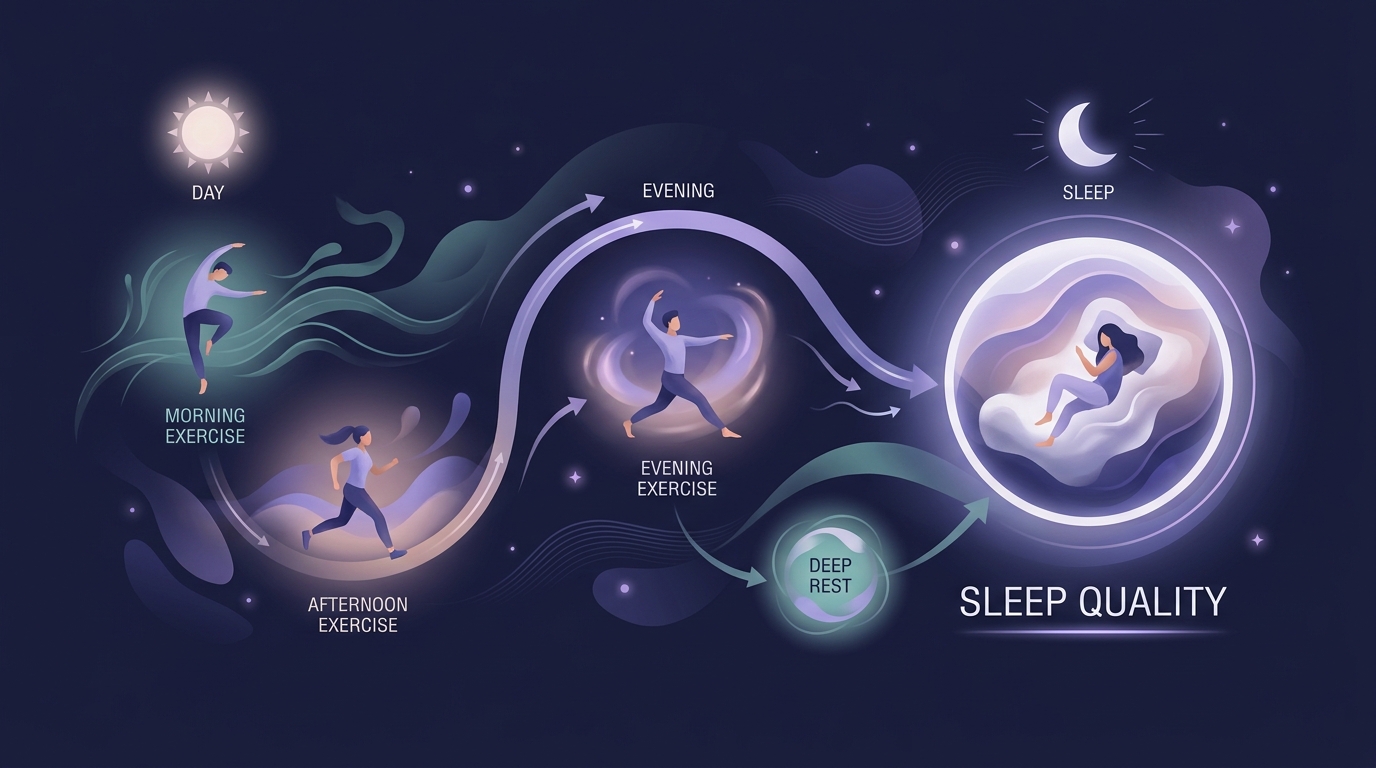
In one of the largest real-world sleep studies ever conducted, researchers analyzed 4.3 million nights of sleep data from approximately 15,000 WHOOP users. Published in Nature, the findings were striking: evening exercise did not hurt sleep quality for the vast majority of people.
In fact, the data revealed that any form of exercise, regardless of when it happened during the day, was better for sleep than no exercise at all. The old assumption that evening activity acts like a shot of espresso to your nervous system simply didn’t hold up across millions of real-world nights.
What 22 Clinical Trials Tell Us
While wearable data gives us massive scale, clinical trials give us precision. A recent meta-analysis of 22 randomized controlled trials looked specifically at how regular exercise impacts sleep quality.
The results? Regular exercise improved sleep quality by a significant 2.19 points on standardized sleep indices. But perhaps the most surprising finding was how you exercise matters less than you think. Both vigorous aerobic exercise (like running or cycling) and mind-body exercises (like yoga or tai chi) were found to be equally effective at improving sleep.
For the 50% to 78% of athletes who report sleep complaints in sports science surveys, the answer isn’t necessarily less training—it’s better nervous system management. If you struggle with waking up tired despite exercising, you might also want to read our guide on non-restorative sleep.
The Core Temperature Myth
Why did we think evening exercise was bad in the first place?
The theory was based on core body temperature. To fall asleep, your core temperature needs to drop by about 1 to 2 degrees. Exercise raises your core temperature. Therefore, exercising before bed must prevent sleep.
But science has found a fascinating workaround. When you finish a workout and take a warm shower, blood rushes to the surface of your skin (vasodilation). When you step out of the shower, that heat rapidly dissipates into the cooler air, causing your core temperature to plummet—exactly the physiological trigger your brain needs to initiate sleep.
Want to try these sounds tonight? Sleep Relax has 100+ calming sounds with a built-in sleep timer.
Try Sleep Relax FreeHow to Optimize Your Exercise for Sleep
So, how do you put this new science into practice tonight? Here is a practical framework for mixing physical activity with restorative rest:
- Stop fearing the evening workout: If 7 PM is the only time you can hit the gym, go. The benefits of the exercise far outweigh the minimal (if any) sleep disruption.
- Use the “Cooldown Buffer”: Try to leave at least 90 minutes between the end of a vigorous workout and your head hitting the pillow. This gives your heart rate enough time to settle.
- Finish with parasympathetic breathing: If you’re wired after a late run, spend 3 minutes doing a 4-7-8 breathing exercise. This actively shifts your nervous system from the “fight or flight” sympathetic state to the “rest and digest” parasympathetic state.
- Take a warm shower: Use the vasodilation trick to rapidly drop your core temperature post-workout.
Frequently Asked Questions
Does evening exercise hurt sleep?
For the vast majority of people, no. Studies analyzing millions of nights of data show that evening exercise does not significantly impair sleep quality, provided you allow a short buffer before getting into bed.
Which is better for sleep: cardio or yoga?
Research shows they are equally effective. A meta-analysis of 22 clinical trials found that both aerobic exercise and mind-body exercises improve sleep quality by a similar margin. Choose the one you enjoy enough to do consistently.
What if I feel wired after working out late?
If you fall into the small minority of people who feel genuinely overstimulated by late workouts, focus on nervous system down-regulation. Use slow, paced breathing techniques like the 4-7-8 breathing technique or listen to deep, continuous sounds like brown noise to lower your heart rate and signal safety to your brain.
This article is for informational purposes only and is not a substitute for professional medical advice. If you have persistent sleep issues, please consult a healthcare provider.
Sleep better in 14 nights
A gentle 14-night sleep plan based on CBT-I principles, a one-tap 3am button and calming sleep sounds. Nights 1–3 are free.
Download Sleep Relax