Pink Noise vs White Noise vs Brown Noise: Which Is Best for Sleep?
White noise machine. Pink noise playlist. Brown noise on TikTok. Everyone has a favourite “colour” of noise for sleeping — but what’s the actual difference? And does it matter?
The short answer: yes, it matters. These aren’t marketing labels — each colour represents a genuinely different sound profile with distinct effects on your brain and body. Let’s break down what each one sounds like, what the science says, and how to find your perfect match.
Understanding Noise Colours
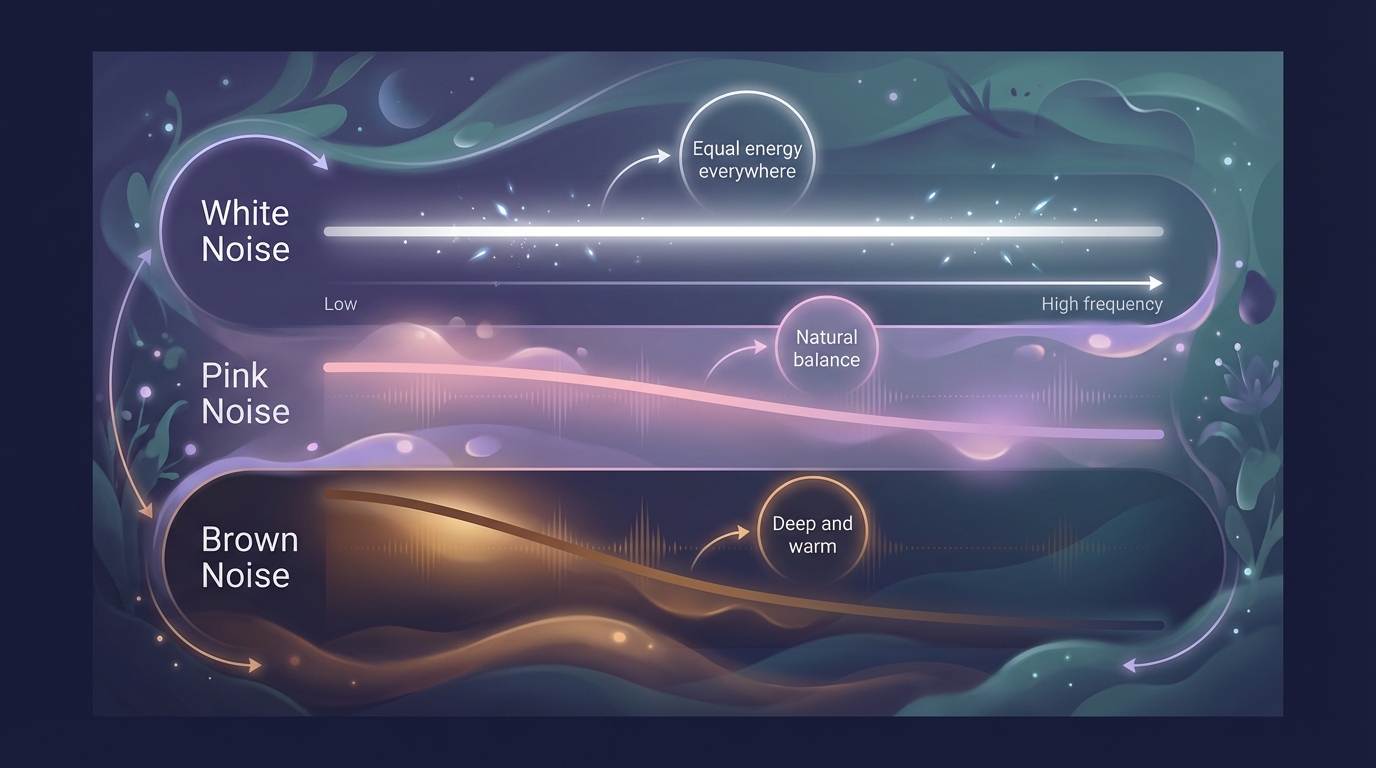
Sound is made up of frequencies — from deep bass rumbles to high-pitched hisses. Noise “colours” describe how energy is distributed across those frequencies. Just like light colours depend on wavelength, sound colours depend on frequency distribution.
White Noise
What it sounds like: TV static, a hissing radiator, a fan on high speed.
The technical bit: Equal energy at every frequency. Your ears perceive this as heavy emphasis on higher frequencies because human hearing is more sensitive to high pitches.
Characteristics:
- Bright, hissy, sharp
- Very effective at masking a wide range of sounds
- Can feel “harsh” to some listeners
- The most well-known and widely available noise colour
Pink Noise
What it sounds like: Steady rainfall, wind through leaves, a waterfall heard from nearby.
The technical bit: Energy decreases as frequency increases — specifically, power drops by 3dB per octave. This creates a more balanced, natural sound.
Characteristics:
- Warmer and more natural than white noise
- Often described as “balanced” or “full”
- Closely matches many natural sounds
- Increasingly studied for cognitive benefits
Brown Noise
What it sounds like: Strong wind, a distant roaring waterfall, the low rumble of an aeroplane cabin.
The technical bit: Energy drops off even more steeply — 6dB per octave. Most energy sits in the bass frequencies.
Characteristics:
- Deep, rumbling, warm
- Least harsh of the three
- Excellent for masking low-frequency environmental noise
- Trending heavily on social media for sleep and focus
For a deeper dive into brown noise specifically, see our complete brown noise guide.
What Does the Science Say?
White Noise Research
White noise has the longest research track record. A 2021 systematic review in Sleep Medicine Reviews found that broadband noise (including white noise) generally improved sleep onset time and reduced nighttime awakenings, particularly in noisy environments like hospitals.
However, some studies have noted that continuous white noise exposure may slightly reduce sleep quality in already-quiet environments — suggesting it’s best used when you actually need sound masking, not as a default.
Pink Noise Research
Pink noise has produced some intriguing results. A 2017 study in Frontiers in Human Neuroscience found that pink noise played during sleep enhanced deep sleep (slow-wave sleep) and improved memory consolidation in older adults.
Another study in PLOS ONE (2012) found that pink noise exposure correlated with more stable sleep patterns. The hypothesis is that pink noise’s frequency profile closely matches the natural frequency patterns of neural activity during sleep.
Brown Noise Research
Brown noise has the least dedicated research, though studies on low-frequency sound exposure suggest calming effects on the autonomic nervous system. Many researchers expect future studies to confirm what millions of users already report — that brown noise’s deep frequencies are particularly effective for relaxation.
Head-to-Head Comparison
| Feature | White Noise | Pink Noise | Brown Noise |
|---|---|---|---|
| Sound character | Hissy, bright | Balanced, natural | Deep, rumbling |
| Best masks | High-frequency sounds (voices, beeps) | Balanced sound masking | Low-frequency sounds (traffic, bass) |
| Harshness | Can feel sharp | Moderate | Gentlest |
| Research support | Most studied | Growing evidence | Least studied, most trending |
| Natural comparison | Fan, static | Rain, wind | Waterfall, thunder |
| Sleep benefit | Sound masking | Deep sleep enhancement | Relaxation, anxiety reduction |
| Best for | Noisy environments | Light sleepers | Anxious or sensitive sleepers |
How to Choose Your Colour
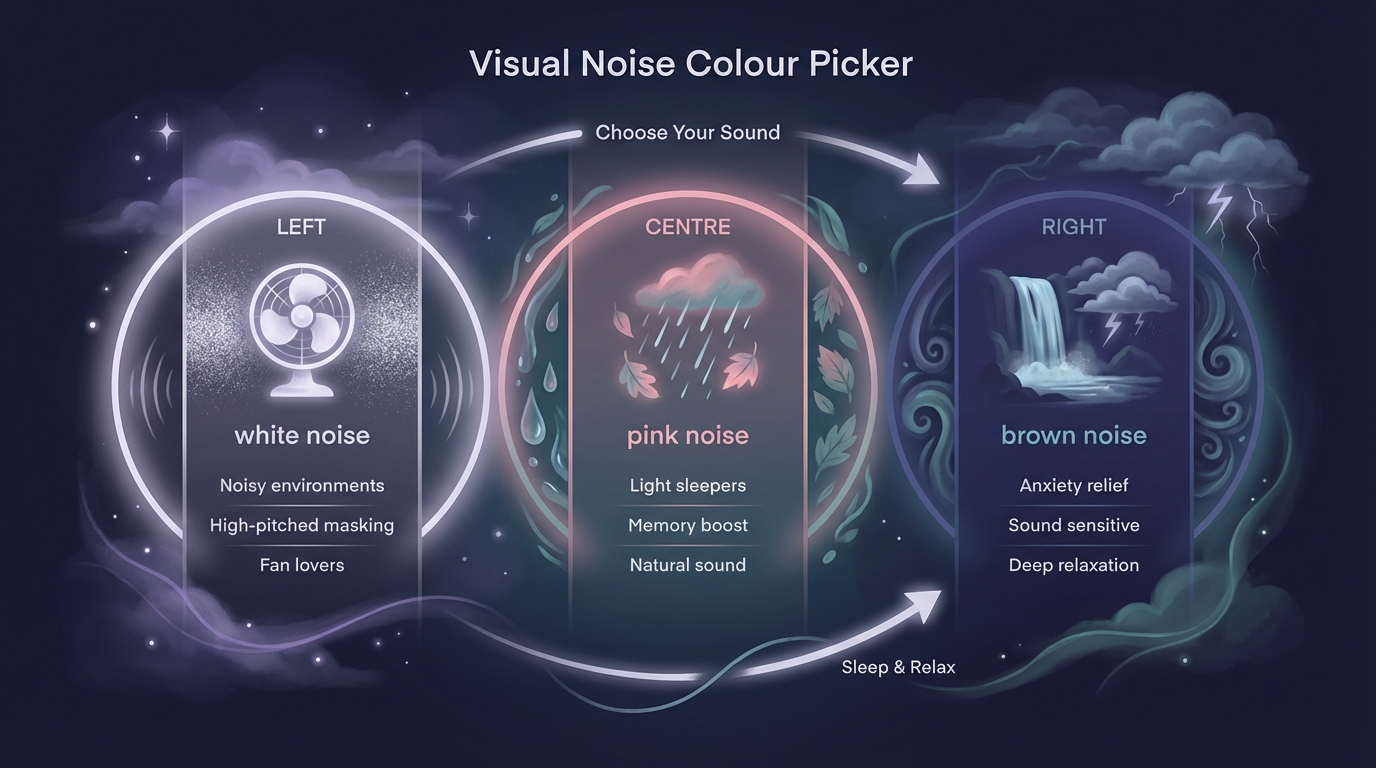
Choose White Noise If:
- You sleep in a noisy environment with varied sounds
- You’re used to fan noise or machine hum
- You need maximum sound masking power
- High-pitched sounds don’t bother you
Choose Pink Noise If:
- You want something natural-sounding
- You’re a light sleeper who wakes easily
- Memory and cognitive function matter to you
- You like the sound of steady rain
Choose Brown Noise If:
- White noise feels too harsh or hissy
- You have anxiety or racing thoughts before bed
- Low-frequency sounds (traffic, bass) disturb your sleep
- You want the most deeply relaxing option
- You have ADHD (many in the ADHD community swear by it)
Or Mix Them
Here’s a secret: you don’t have to choose just one. Many people find their perfect sleep sound by mixing noise colours with natural sounds. Brown noise plus gentle rain is a particularly popular combination.
Sleep Relax includes all three noise colours plus 100+ nature sounds you can mix together. Find your perfect blend tonight.
Try Sleep Relax FreeThe “Best” Noise Is the One That Works for You
Sleep research consistently shows that individual variation is enormous. A sound that puts one person to sleep in minutes might keep another person awake. The colour that works for your partner might not work for you.
The good news is that finding your match is quick:
- Try each colour for 2-3 nights
- Notice how quickly you fall asleep and how you feel in the morning
- Experiment with mixing colours and adding nature sounds
- Pay attention to volume — too loud hurts sleep quality regardless of colour
Beyond Colours: Other Sleep Sounds
Noise colours are a great starting point, but the world of sleep sounds extends much further:
- Rain sounds — one of the most popular sleep sounds, combining pink/brown noise with natural rhythm
- Breathing exercises — sometimes the best “sound” for sleep is your own breath
- Nature sounds — ocean waves, forest ambiance, crickets
- Binaural beats — frequency-based audio that some find helpful for relaxation
The key is experimentation. Your brain is unique, and your perfect sleep sound is waiting to be discovered.
Quiet nights ahead. 🌙
Sleep better tonight
100+ calming sounds, breathing exercises, and a sleep timer — all in one app.
Download Sleep Relax