The Sleep Effort Paradox: Why Trying to Sleep Keeps You Awake
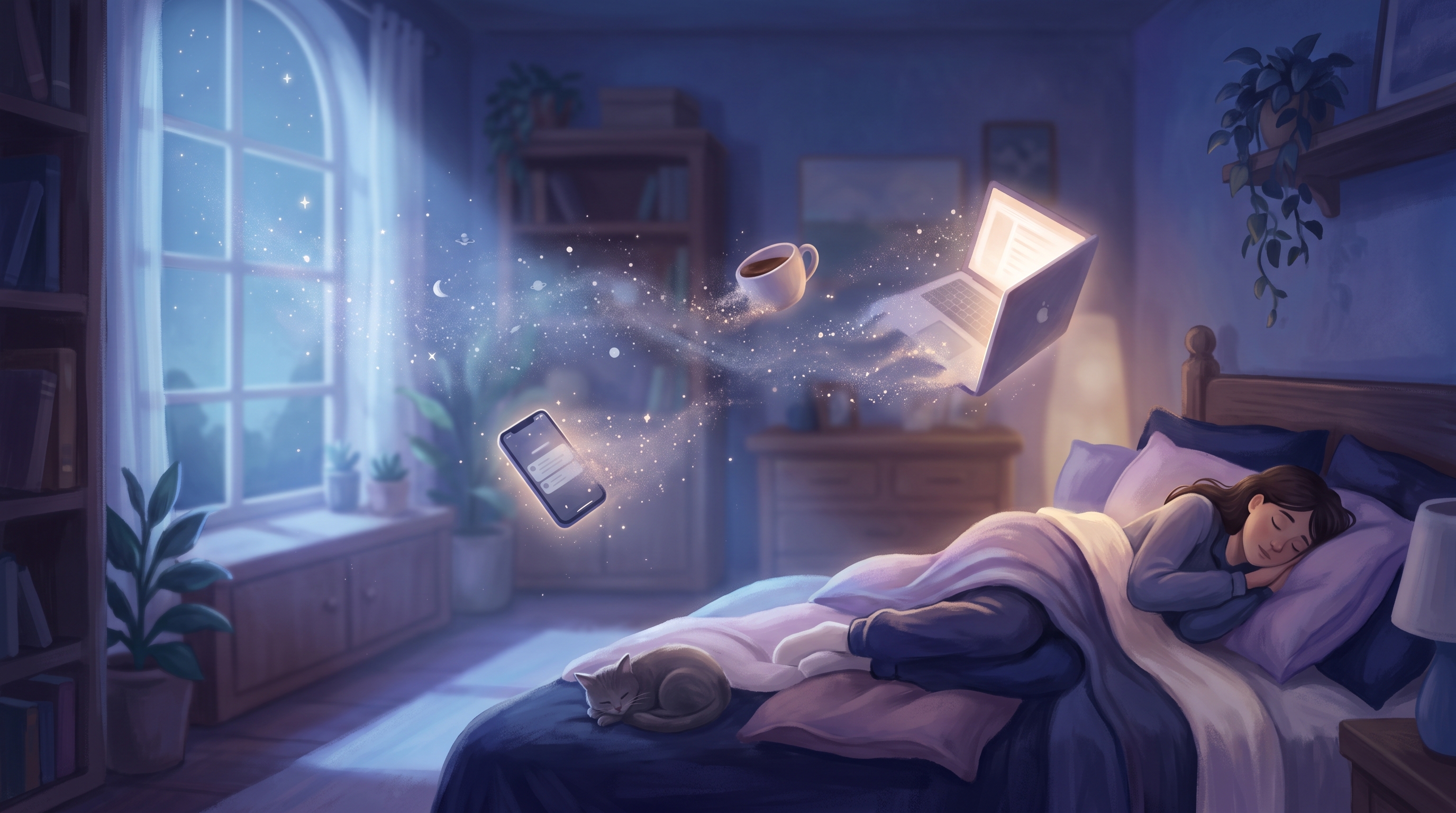
You’re lying in bed, exhausted. Your eyes are heavy, your body aches from the day, and you know — with absolute certainty — that you need sleep. So you close your eyes, settle into your pillow, and… nothing. Minutes pass. You adjust your position. You breathe deeply. You think calming thoughts. Still nothing.
Now you’re frustrated. Now you’re watching the clock. Now you’re doing maths: “If I fall asleep right now, I’ll get five hours and forty-three minutes.” And with each passing minute, sleep retreats further, like trying to grab water — the tighter you squeeze, the less you hold.
This is the sleep effort paradox, and it may be the most common yet least understood cause of insomnia.
Why Effort Is the Enemy of Sleep
Sleep is one of the few biological processes that you cannot achieve through willpower. You can will yourself to run faster, concentrate harder, or hold your breath longer. You cannot will yourself to sleep. Sleep only arrives when you stop trying.
This isn’t a metaphor. Research from the University of Glasgow found that insomnia patients who were instructed to try to stay awake (with their eyes open, no screens or reading) actually fell asleep faster than those told to try to fall asleep. The technique, called paradoxical intention, works precisely because it removes the effort.
The reason is neurological. When you try to make yourself sleep, you activate your prefrontal cortex — the executive planning centre. You set a goal (“fall asleep”), monitor your progress (“am I asleep yet?”), and evaluate the outcome (“no, still awake”). This is exactly the kind of cognitive engagement that promotes wakefulness. You’re essentially running a project management meeting in the part of your brain that needs to go offline for sleep to begin.
Meanwhile, sleep onset requires the opposite: a gradual deactivation of the cortical arousal system, a handoff from waking consciousness to the thalamic sleep circuits. Effort prevents the handoff.
The Anxiety Feedback Loop
The sleep effort paradox becomes truly destructive when it creates a self-reinforcing cycle:
Bad night → worry about sleep → increased effort → worse night → more worry
Sleep researchers call this “conditioned arousal” or “learned insomnia.” After a few bad nights — maybe triggered by stress, illness, or jet lag — your brain begins to associate the bed itself with the struggle to sleep. The bedroom becomes a performance arena rather than a rest environment.
Dr. Michael Breus, a clinical sleep psychologist, describes it as “sleep performance anxiety” — the same mechanism that causes stage fright or test anxiety. The stakes feel high (you need sleep to function), the audience is watching (the clock), and the harder you try, the worse you perform.
Over time, this conditioning becomes automatic. You might feel perfectly sleepy on the sofa watching a film, but the moment you walk into the bedroom and get into bed, a subtle alertness switches on. That’s your brain activating threat-detection mode in the space where you’ve repeatedly experienced frustration.
You’re Not Broken — You’re Trying Too Hard
If this pattern sounds familiar, here’s the first thing to understand: there is almost certainly nothing wrong with your ability to sleep. The evidence is that you’ve been sleeping your entire life without trying. Sleep is a deeply conserved biological function — your brain is exquisitely good at it.
What’s happened is that you’ve accidentally inserted effort into a process that works best without it. It’s like trying to manually control your heartbeat or your digestion — the conscious mind gets in the way of systems that are designed to run automatically.
Colin Espie, a professor of sleep medicine at the University of Oxford, uses the analogy of walking. Walking is automatic — you don’t think about each muscle contraction. But if someone asked you to walk “perfectly” across a room while being watched and timed, you’d suddenly become stiff and awkward. That’s what happens when you try to “do” sleep.
What Actually Helps
The good news is that the sleep effort paradox has well-studied solutions. The bad news is that they all require you to stop doing the thing that feels most logical.
Stop Trying to Sleep
This sounds absurd, but it’s the foundation of every evidence-based insomnia treatment. Instead of going to bed with the goal of sleeping, go to bed with the goal of resting. Lie down, close your eyes, and let your mind drift. If sleep comes, it comes. If it doesn’t, you’re still resting — and rest has genuine physiological value even without sleep.
The mindset shift from “I must fall asleep” to “I’m going to rest comfortably” removes the performance pressure. There’s no failing at resting.
Stimulus Control: Protect the Bed-Sleep Link
If you’ve been lying awake in bed for more than about 20 minutes, get up. Go to another room, keep the lights dim, and do something low-stimulation — read a physical book, listen to a gentle soundscape, do some slow stretching. Return to bed only when you feel genuinely drowsy.
This technique, developed by sleep researcher Richard Bootzin in the 1970s, remains one of the most effective insomnia interventions ever studied. It works by re-training your brain to associate the bed with sleep, not with wakefulness and frustration.
The rule is simple: bed is for sleep. If you’re not sleeping, don’t be in bed.
Replace Effort With Sensation
When your mind is racing with “why can’t I sleep?” thoughts, you need to redirect attention somewhere that doesn’t involve monitoring your sleep state.
Slow breathing works well here — not as a sleep technique, but as an attention anchor. A gentle 4-count inhale and 6-count exhale gives your mind something rhythmic and physical to focus on. You’re not breathing to fall asleep. You’re breathing because it feels good and gives your executive brain something to do that isn’t project-managing your consciousness.
Body scanning works on the same principle. Moving your attention slowly from your toes to your head, noticing weight and warmth, engages your somatosensory cortex and quietly disengages the verbal-analytical circuits that drive anxious wakefulness.
Want to try these sounds tonight? Sleep Relax has 100+ calming sounds with a built-in sleep timer.
Try Sleep Relax FreeBuild Your Sleep Drive
One reason the effort paradox strikes so hard is that some people go to bed before they’ve accumulated enough sleep pressure. Adenosine — the chemical that builds up during waking hours and creates the urge to sleep — needs time to accumulate.
If you’re going to bed early because you’re anxious about not getting enough sleep, you may be lying there without sufficient biological sleep drive. Counter-intuitively, going to bed a bit later (when you’re genuinely drowsy, not just tired) can make falling asleep dramatically faster.
Sleep restriction therapy, a core component of Cognitive Behavioural Therapy for Insomnia (CBT-I), works on this principle. By temporarily compressing your time in bed to match your actual sleep time, you build up intense sleep pressure that overwhelms the effort response.
Let Sound Do the Work
One of the most elegant solutions to the sleep effort paradox is ambient sound. A consistent, gentle soundscape — rain on a window, soft brown noise, ocean waves — gives your brain something to attend to that doesn’t require effort or monitoring.
Unlike silence (which your alert brain fills with anxious thoughts) or active techniques (which risk becoming another thing to “try”), ambient sound is passive. You don’t have to do anything with it. It simply fills the cognitive space where effort-thoughts would otherwise live.
Research suggests that predictable ambient sounds reduce the time to sleep onset partly by masking environmental noise, but also by providing a stable sensory environment that signals safety to the brain’s threat-detection system.
The Deeper Pattern
The sleep effort paradox is really about a broader truth: some of the most important things in life work through surrender, not control. Creativity, relaxation, trust, sleep — they all arrive when you create the conditions and then get out of the way.
For chronic insomniacs, this is genuinely difficult, because months or years of bad nights have created deep grooves of anxiety around sleep. If that’s you, CBT-I (Cognitive Behavioural Therapy for Insomnia) is the gold-standard treatment, recommended as first-line therapy ahead of medication by every major sleep medicine organisation. It works specifically by dismantling the effort-anxiety cycle.
But even for the occasional bad night, the principle holds: the less you try to sleep, the faster it comes.
Tonight, when you get into bed, try this: instead of closing your eyes and commanding your brain to sleep, just lie there. Listen to the sounds around you — or put on a soundscape if the silence feels heavy. Notice how the pillow feels against your head. Let your breathing happen without directing it. You’re not trying to do anything. You’re just here.
Sleep is already on its way. It doesn’t need your help.
This article is for informational purposes only and is not a substitute for professional medical advice. If you have persistent sleep issues, please consult a healthcare provider.
Frequently Asked Questions
How do I know if I have sleep performance anxiety?
The clearest sign is that you can fall asleep easily in “wrong” places — the sofa, a friend’s house, a hotel — but struggle in your own bed. If the bedroom is the specific environment where sleep feels difficult, conditioned arousal is likely at play. Other signs include checking the clock repeatedly, mentally calculating how much sleep you’ll get, and dreading bedtime.
Is it normal to take more than 10 minutes to fall asleep?
Yes. Sleep onset latency (the time from lights-out to sleep) varies widely between individuals. Anything up to about 20 minutes is considered normal and healthy. Falling asleep the instant your head hits the pillow actually suggests sleep deprivation rather than good sleep ability. A healthy sleeper drifts off gradually.
Can sleep apps make the effort paradox worse?
They can, if they become another thing to monitor and optimise. Sleep tracking scores can create what researchers call “orthosomnia” — anxiety driven by sleep data rather than actual tiredness. If you often wake up feeling tired despite sleeping, the issue may be sleep quality rather than quantity. If checking your sleep score first thing in the morning is causing stress, consider stepping back from tracking for a while. The goal is to reconnect with how you feel, not what a number says.
Sleep better in 14 nights
A gentle 14-night sleep plan based on CBT-I principles, a one-tap 3am button and calming sleep sounds. Nights 1–3 are free.
Download Sleep Relax