
Sleep Meditation: A Practical Guide to Falling Asleep with Your Mind
It’s 11pm. You’re exhausted but your mind won’t stop. Tomorrow’s meeting. That email you forgot to send. Whether you locked the front door. The harder you try to sleep, the further away it feels.
This is where sleep meditation comes in — not as some mystical practice that requires years of training, but as a practical technique that redirects your racing mind toward rest. And the science behind it is surprisingly solid.
Why Your Mind Won’t Let You Sleep
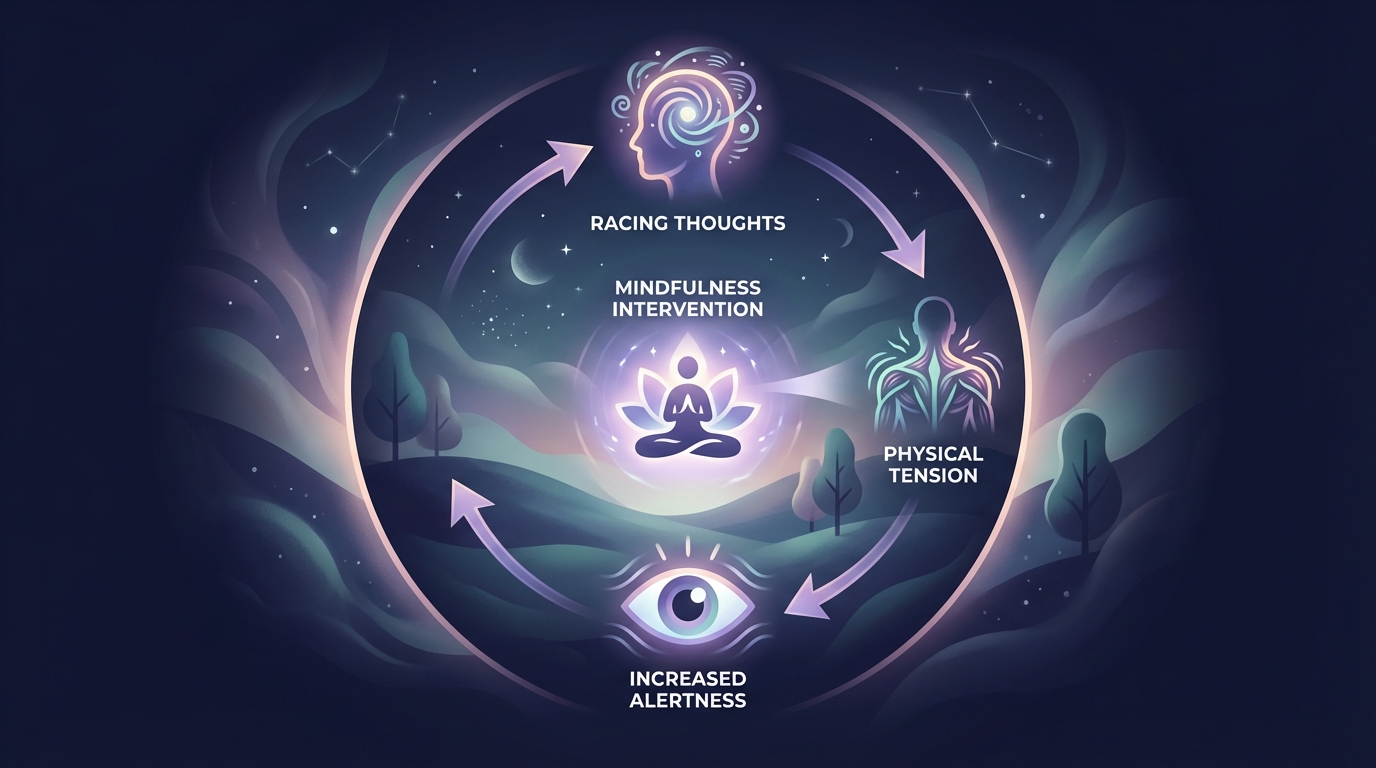
The problem isn’t that you’re not tired. It’s that your brain is stuck in what researchers call hyperarousal — a state where your sympathetic nervous system (the “fight or flight” system) stays active even though there’s nothing to fight or flee from.
Your body is in bed. Your brain is still at your desk.
Sleep meditation works by deliberately activating your parasympathetic nervous system — the “rest and digest” counterpart. It shifts your attention away from anxious thoughts and toward physical sensations, breath, or imagery that your brain interprets as safe. When your brain feels safe, it lets go.
A 2015 study published in JAMA Internal Medicine found that mindfulness meditation significantly improved sleep quality in older adults with moderate sleep disturbance — and the effects were comparable to sleep hygiene education, but with additional benefits for daytime fatigue and depression.
Sleep Meditation vs Regular Meditation
If you’ve tried meditation apps and found yourself more alert afterwards, that’s by design. Most meditation practices aim to sharpen focus and increase present-moment awareness — the opposite of what you want at bedtime.
Sleep meditation is different. The goal isn’t clarity or insight. The goal is to bore your brain into surrender.
Good sleep meditations share these traits:
- Slow, monotone guidance — no dramatic pauses or energising cues
- Progressive relaxation — systematically releasing tension from your body
- Fading structure — the meditation gradually does less, giving your mind permission to drift
- No “come back to the breath” prompts — if your mind wanders toward sleep, that’s a win, not a failure
This is also what makes sleep meditation different from the meditation sounds for beginners approach — there, you’re building a practice. Here, you’re building a bridge to unconsciousness.
Three Techniques That Actually Work
1. The Body Scan
The body scan is the most research-backed sleep meditation technique, and it’s beautifully simple. You systematically bring attention to each part of your body, noticing sensations without trying to change them.
How to do it:
- Lie on your back with arms at your sides, eyes closed
- Start at the top of your head — notice any warmth, pressure, or tingling
- Move slowly downward: forehead, eyes, jaw, neck, shoulders
- Spend 3-5 breaths on each area before moving on
- Continue through your chest, arms, hands, stomach, hips, legs, feet
- If you fall asleep before reaching your feet — congratulations, it worked
The key is passive attention. You’re not relaxing your muscles on purpose (though that often happens). You’re just noticing. This gives your brain something incredibly boring to do, which is exactly what it needs.
2. Guided Visualisation
Your brain processes vivid imagery almost like real experience — which is why nightmares wake you up and why calming scenes can ease you to sleep.
A simple sleep visualisation:
Picture yourself in a warm, safe place — a cabin by a lake, a hammock in a garden, a quiet beach at dusk. Don’t just see it. Feel the temperature on your skin. Hear the ambient sounds. Notice the quality of the light.
Build the scene slowly, adding one sensory detail at a time. The slower and more detailed you make it, the more your brain shifts from analytical mode to experiential mode — and experiential mode is much closer to sleep.
3. The Breathing Anchor
If body scans feel too structured and visualisation doesn’t stick, try anchoring your attention to your breath without trying to control it.
Simply notice: air coming in, air going out. When your mind wanders (it will), gently bring it back. No counting, no timing, no technique — just noticing the breath as it is.
This works well combined with the 4-7-8 breathing technique for the first few minutes, then transitioning to passive observation as you feel yourself getting drowsy.
Want to try these sounds tonight? Sleep Relax has 100+ calming sounds with a built-in sleep timer.
Try Sleep Relax FreeHow to Build a Sleep Meditation Habit
The biggest mistake people make with sleep meditation is treating it like an emergency tool — reaching for it only on the worst nights and expecting immediate results.
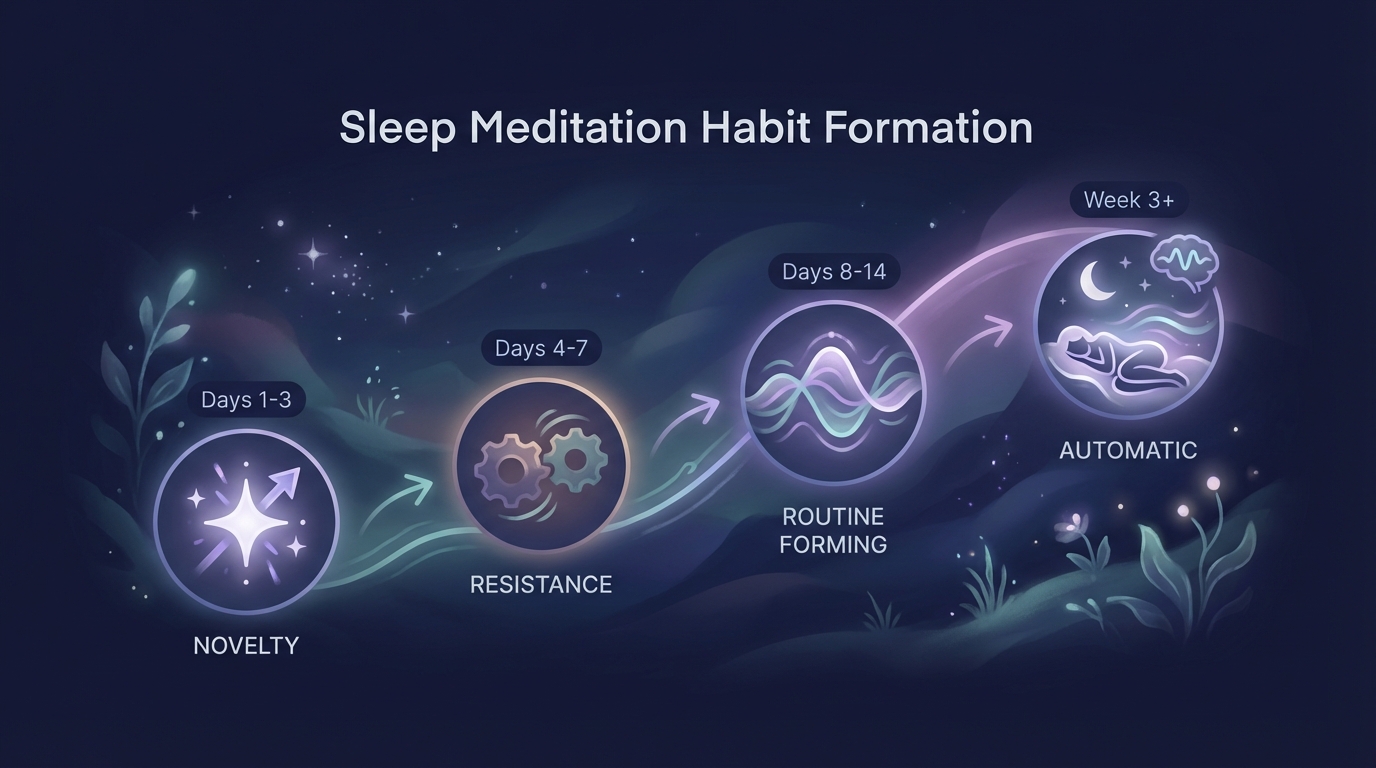
Meditation works better as a signal. When you meditate at bedtime consistently, your brain starts associating the practice with sleep. After a week or two, simply starting a body scan can trigger drowsiness because your brain has learned what comes next.
Practical tips for the first two weeks:
- Same time, same place. Do your meditation in bed, lights off, ready to sleep. Don’t meditate on the sofa and then move to bed — you’ll wake yourself up.
- Start with guided. Use a guided sleep meditation until the pattern feels natural. Sleep Relax includes guided meditations designed to fade out as you drift off — they won’t jolt you awake at the end.
- Keep it short. 10-15 minutes is enough. Long meditations can cause frustration if you’re still awake at the 30-minute mark.
- Don’t judge the session. Some nights you’ll fall asleep in five minutes. Others you’ll still be awake at the end. Both are fine. The practice is training your brain over time, not performing on demand.
What If Meditation Makes You More Anxious?
Some people find that lying still with their eyes closed makes anxiety worse. Thoughts get louder. Silence feels oppressive.
If that’s you, try these adjustments:
- Add background sound. Pair your meditation with rain sounds or brown noise. Ambient sound fills the silence and gives your brain less room to spiral.
- Keep your eyes slightly open. A soft, unfocused gaze at a dim spot on the ceiling can prevent the “trapped in my own head” feeling.
- Use a body-based technique. Body scans work better for anxious minds than breath-focused meditation because they distribute attention across your whole body rather than narrowing it to one point.
- Start with just five minutes. Build tolerance gradually. Meditation is like a muscle — pushing too hard too early creates resistance.
If anxiety during meditation is persistent and severe, that’s worth mentioning to a healthcare provider. Sleep meditation is a tool, not a treatment for clinical anxiety.
The Sound Connection
Meditation and sound aren’t separate strategies — they work best together. Research on sleep and auditory processing shows that certain sounds actively promote the brain wave patterns associated with deep sleep.
Pairing a body scan with steady ambient sound creates two layers of sleep support: the meditation redirects your attention while the sound masks external disruptions and promotes neural entrainment. It’s the one-two combination that makes apps like Sleep Relax particularly effective — you can layer a guided meditation over your favourite sleep sounds.
Start Tonight
You don’t need special equipment, training, or even a quiet room. Tonight, try this:
- Get into bed. Lights off.
- Put on some gentle ambient sound if you like.
- Close your eyes and bring your attention to the top of your head.
- Slowly scan downward, spending a few breaths on each body part.
- If you fall asleep before your toes — perfect. If you don’t, that’s fine too. You’ve given your brain 10 minutes of genuine rest.
Do this for a week. By day four or five, you’ll likely notice you’re falling asleep faster — not because of magic, but because you’ve given your brain a reliable off-ramp from the day.
Want to try these sounds tonight? Sleep Relax has 100+ calming sounds with a built-in sleep timer.
Try Sleep Relax FreeThis article is for informational purposes only and is not a substitute for professional medical advice. If you have persistent sleep issues, please consult a healthcare provider.
Sleep better tonight
100+ calming sounds, breathing exercises, and a sleep timer — all in one app.
Download Sleep Relax